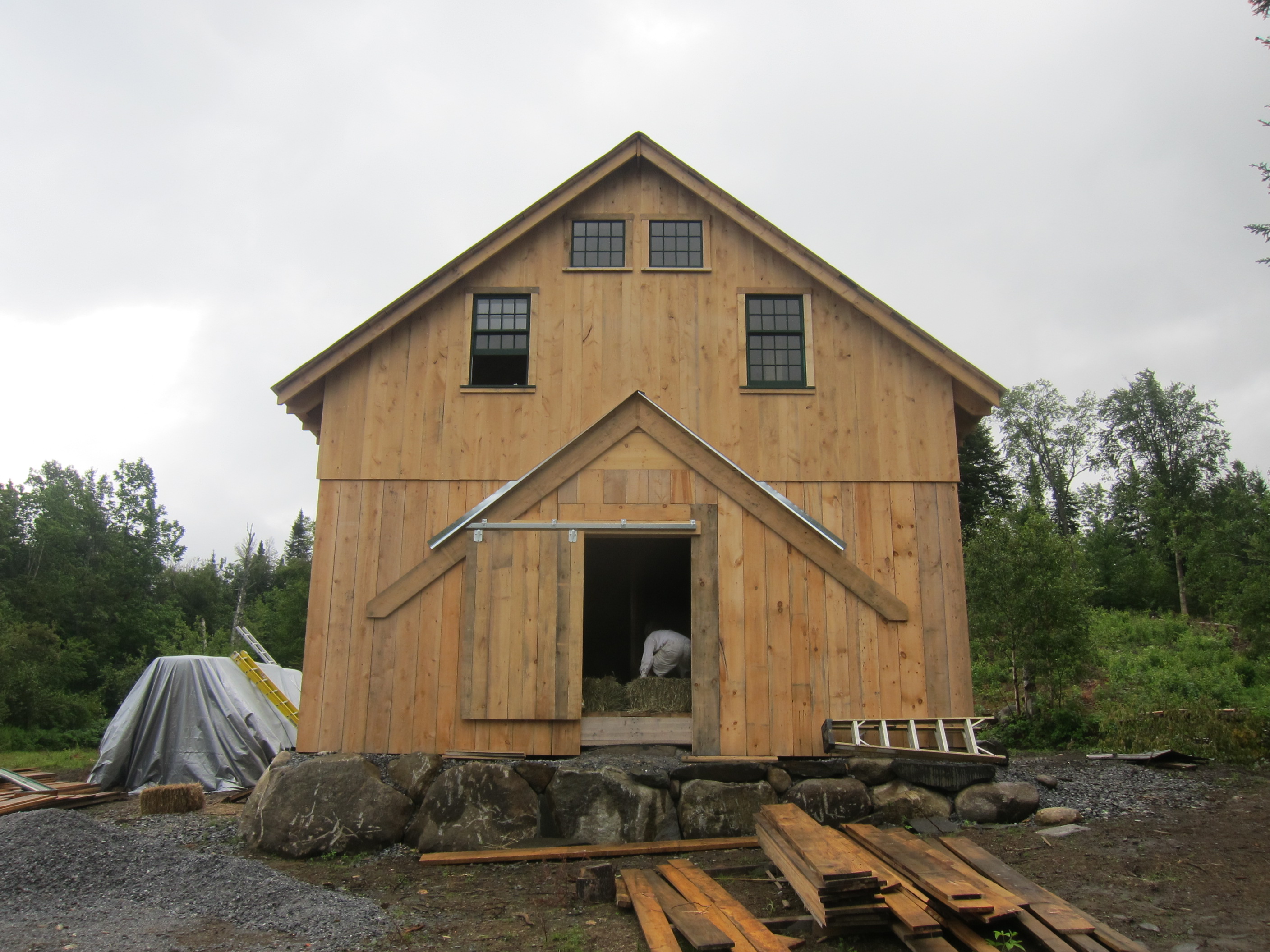
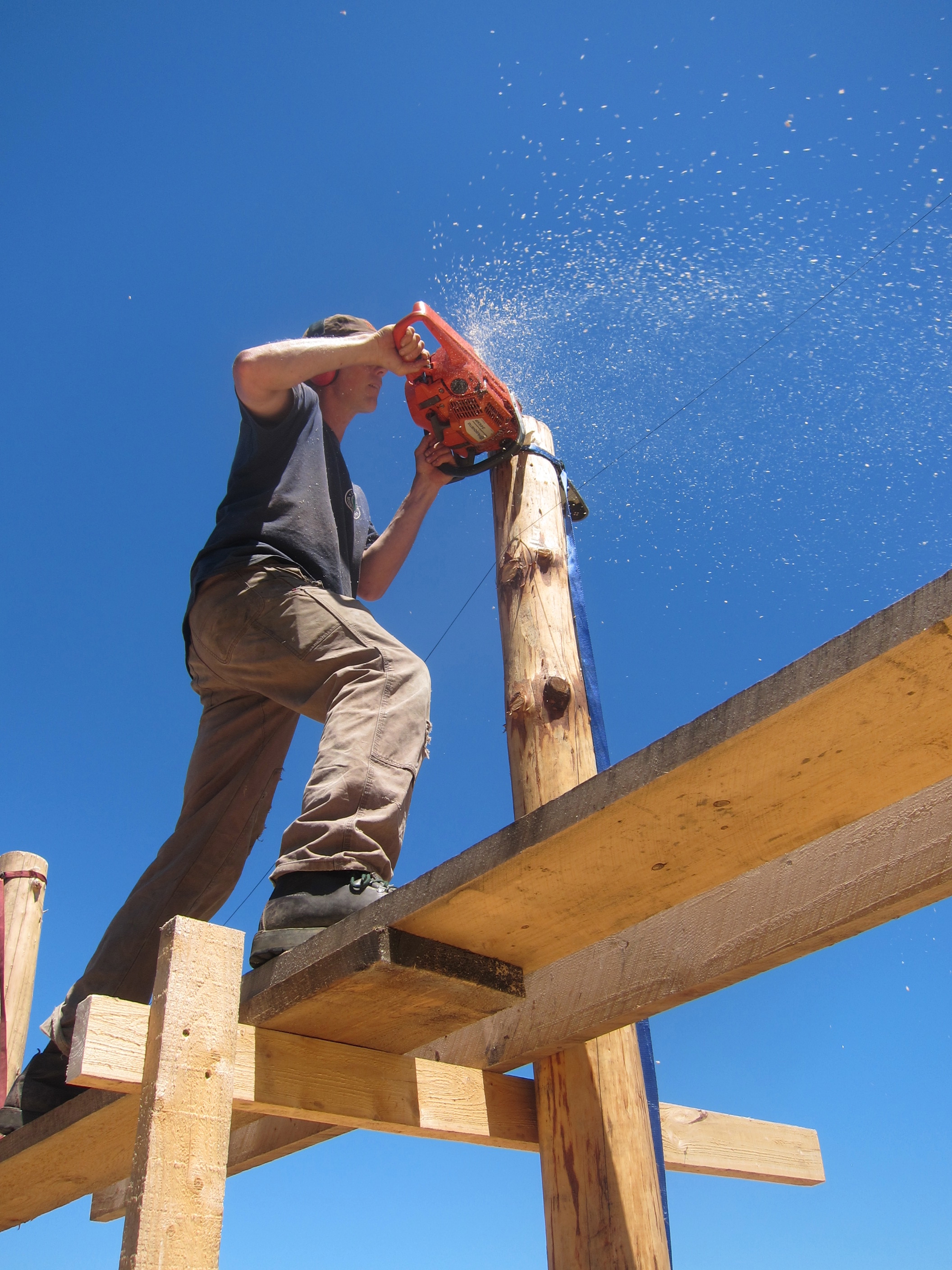
Saturday I worked on the barn until later than usual, and on my drive home I felt worn out and undone. I drove home the back way, slowly, one hand on the wheel, the other hanging out the window. Every so often, I’d raise my hand to catch the breeze, float it on the push of air, a small airplane of flesh, blood, and bone. But soon even this required more effort than I wanted to expend, and I let it rest heavy against the truck door.
Then, a raven, flying just ahead of and above the truck, tracing the road’s path. Thirty miles an hour he flew, or nearly so, and he stayed with me for almost a mile. Leading me. Being pushed by me. No, that’s ridiculous: Just flying. I watched, an eye on the bird and one on the road, until we came to a field and the trees opened and he cut a hard right over the long expanse of grass, and for the briefest of moments, one of those fleeting fantasies in which the laws of both physics and man can be unwritten, I thought about turning with him.
The heat came on hard and fast. It’s been 90 or close enough for three days straight, the air heavy with moisture. You’d swear you can feel its weight. Something else to carry. I don’t mind, really, so long as I don’t think about minding. See how that works?
My summer reading thus far has consisted of the occasional New Yorker article, the back issues of the Sun my mother loaned me, and Chris Hedges’s book Empire of Illusion: The End of Literacy and the Triumph of Spectacle. (Our subscription to Harper’s ran out and I keep forgetting to re-up, otherwise that’d be in there, too).
I like Hedges’s work. Or I like his thinking, at least. He doesn’t pull any punches, and Empire of Illusion is no different. It’s about how the cult of celebrity and other mass media, pop culture offerings only serve to distract us from the real issues of our private lives and society. It reminds me of an ongoing conversation Michael and I have been having, snatches of conversation between the swinging of hammers and the sawing of lumber (this is how conversation works on a job site, in little stilted passages that are dropped off and picked up again as the clamor allows), about the ways in which social media undermine our sense of self-worth. Neither of us spends much time online (though myself more than him, that’s for sure), but enough to have a feel for the terrain. Enough to understand that the people who get the most attention in social media spheres are generally the most attractive, the funniest, most clever. The ones with the particular skill of making their lives appear effortlessly beautiful and fulfilling.
I’ve read that there’s a correlation between time spent online and depression, and I always figured it was mostly because being online is a sedentary habit. In my experience, there’s not much like sitting and passively staring at a screen to bring on the blues (I think there is a distinction to be made between passive computer use and the use of the computer as a tool for creativity). But I’m starting to wonder if the issue is only partly physical, and also (if not mostly) the inevitable self-assessing we do in relation to the endless stream of beautiful images of beautiful people and their beautiful lives.
I cringe a little inside when people tell me they live vicariously through my words and Penny’s pictures. I mean, maybe it’s ok. Maybe it’s feeding something in them that can’t be fed otherwise, maybe it’s a coping mechanism, or simple escapism. We all need a little simple escapism in our lives, myself included. And lord knows I try hard to make this space more than just something to look at, something to admire, or even aspire to.
I guess what I’m saying is (and I’ve said it before): Recognize the two-dimensionality of this space and, by default, the superficiality of the entire sphere of social media. Remember that no one’s life is effortless. Everyone struggles. Everyone is, on some level or another, ordinary, with all the ordinary flaws and quirks of human character. If you were here right now, you’d see the chaos of our kitchen, the dirty footprints on its floor. You’d see the dirty clothes piled behind my office chair, the dust bunnies in the corner. No, not bunnies: Lions. Roaring lions of dust and debris. You’d hear me singing REO Speedwagon’s Ridin’ the Storm Out, and then, you’d hear Penny tell me to kindly shut the hell up. Only she wouldn’t say “hell.” (I got a letter berating me for my use of the word “fuck,” which is maybe a topic for another day). Later, at the job, you might overhear my wife and I bickering over some minor, perceived slight. Or maybe it won’t be minor. Maybe it won’t be perceived.
Empire of Illusion was published in 2009, before the rise of Twitter and Instagram and all the other platforms we can use to create illusions of our own. Everything Hedges said then seems doubly apropos now, and it seems to me as if there’s no end in sight, perhaps because our culture’s hunger for illusion is insatiable. Of course, this means it is also profitable.
I always like it when I can close on a witticism, or some particularly profound observation. Alas, today again the air is hot and heavy, my wit worn thin by list of tasks before me and those already completed. So I guess all I’ll say is this: Beware the two-dimensionality of this medium. Indeed, beware the ways in which this medium cultivates two-dimensionality, and, not-inconsequently, foments our own feelings of inadequacy and dissatisfaction in the perceived ordinariness of our lives. Though the truth is, of course, that your life, just like mine, is ordinary. And that’s perfectly ok.
Remember, even, that synonyms for vicarious include secondhand, derivative, surrogate, substitute. There are many, many ways to live a meaningful and fulfilling life. But I’m pretty sure that these are not some of them.
There is much more to say about the pleasures of so-called “peasant labor,” particularly in the wake of my romanticized, self-satisfied babble a few days back.
I must first say this: Yes, I love physical work, and I have at least a middling capacity for it (unless wittle Benny gets a boo-boo, in which case all bets are off until I’ve fully rehabilitated my blister). And yes, it does occasionally feel to me as if the work I do to earn my moneyed living is, to quote something I read recently “white collar, desk-bound, pontificating bullshit.” So there’s that. But the larger truth is that I’m incredibly grateful to be able to provide financial support to my family in the manner I do, and the minute I stop being grateful is the minute someone should just haul off and slap me upside the head.
There was comment the other day about someone’s father or maybe uncle, about how he worked construction his whole life, never turning down the overtime, and now his body is a wreck. Maybe the work was good while his joints and muscles held up, maybe he actually loved it. Or maybe not. But either way, he did the good, honest labor, and it twisted him up, wrung the health and vitality right out of him.
The same day, I heard on the radio, on a call-in talk show, yet another despairing conversation about the state of our nation’s educational system, about how we really need to be sure we get more kids into college, about how we’ll never compete as a nation if we don’t send more young adults to university, about how it used to be enough to maybe get a high school degree, and then you needed at least two years of college, but now, if you don’t have at least a bachelor’s degree and maybe even some sort of post-graduate paper, well… you lose, sucka. I’d link to it, but I’m not willing to risk you wasting your precious time listening. Besides, you can hear the same damn conversation in a million different places every day of the friggin’ week.
These things are connected, of course. The wrung out father/uncle, the ceaseless lament about our nation’s ability to compete on the global stage and how we must push our children harder, funnel them more efficiently into the higher educational system, give them the tools they need to compete amongst themselves. Because we all know college graduates earn more money over their lifetimes, right? Because we all know the science-and-technology-heavy jobs of the future require more than a high school diploma.
Hey, I got a question for ya: Whose gonna build your fucking house? Who is going to saw the timber to make your toilet paper? Who is going to grow your food, make your clothing (what’s that? Chinese children? Ah, I see. No worries, then), fix your car, unclog your septic, maintain the playground with that neat merry-go-round your kids love so much? Who’s going to play the music you listen to on your way to work? None of these require college degrees. Not a friggin’ one. All are essential, honorable work. Way more essential and honorable than creating apps or yet another platform for posting selfies on the internets. Probably even more essential and honorable than writing for a living, though I’m loathe to admit as much.
Hey, I got an idea for ya: What if we, as a society, stopped worrying so damn much about our nation’s ability to compete. About our children’s ability to compete. What if we recognized that, sure, college can be a great thing for some people, and we should do what it takes to make college accessible to those people. But what if, concurrently, we stopped creating this manufactured stigma (is there any other kind?) about those who choose differently, and furthermore, we started paying them a wage commensurate with their role in keeping our society on its feet. Maybe then the commenters father/uncle wouldn’t have had to take all that overtime. Maybe then his body wouldn’t hurt so much when he wakes up in the morning. Maybe then children who are not cut out for college wouldn’t feel like second-class citizens. Maybe then they wouldn’t be treated like second-class citizens. Maybe then we’d stop destroying the biosphere in our clawing, kicking, screaming scramble to compete with other nations. With other humans.
I know many people who went to college, and many who didn’t. Maybe it’s just the oddball folks I associate with, but I honestly can’t say that those who graduated college are doing better than those who didn’t. Might be making more money, sure, but are they overall enjoying their lives more? Not that I can tell. Are they engaged in honorable, even righteous work? Many are. But are you telling me there’s something more honorable than selling firewood? Than milking cows or building houses? Fuel. Food. Shelter. Seems pretty damn honorable to me.
When people ask if I’m concerned about my children’s ability to gain entrance into college, I can honestly say that I’m not worried in the least. Partly, I’m not worried because I know that if they want to go to college badly enough – if there’s something they are passionate about learning that can only be learned in such a place – I know they’ll figure out how to make it happen. But the other reason I’m not worried is because I have seen with my own two eyes that it is still possible to build a good and worthy and fulfilling life without a college degree. Is it getting harder to do so? Yes, I believe it is. But of course the primary reason it’s getting harder is because we are gullible enough believe the stories we are told about education and competition. We listen to programs like the one I heard and we lament right alongside the invited guests and the call-in listeners, and our lament leads to worry, and so we bundle our kiddos up and put them on the college train without even considering whether or not they’re the least bit interested in the destination.
I believe that laments like the one I heard on the radio are built around a myth, one that is perpetuated because it serves broader stories of economics and success. This myth loves nothing more than people competing against one another for their share (and more!) of the resources our industries churn out. Like so many of the stories we are told and sold, it’s a myth that’s become so pervasive that we are no longer aware it’s anything but the gospel truth. And that, more than anything else, is what makes it dangerous. As ever, the things we should be wary of are generally not the things we’re told to be wary of, but rather the things we don’t even know to look out for in the first place.
Damn. All that and not even 5:30 a.m. It’s gonna be a hell of a day.
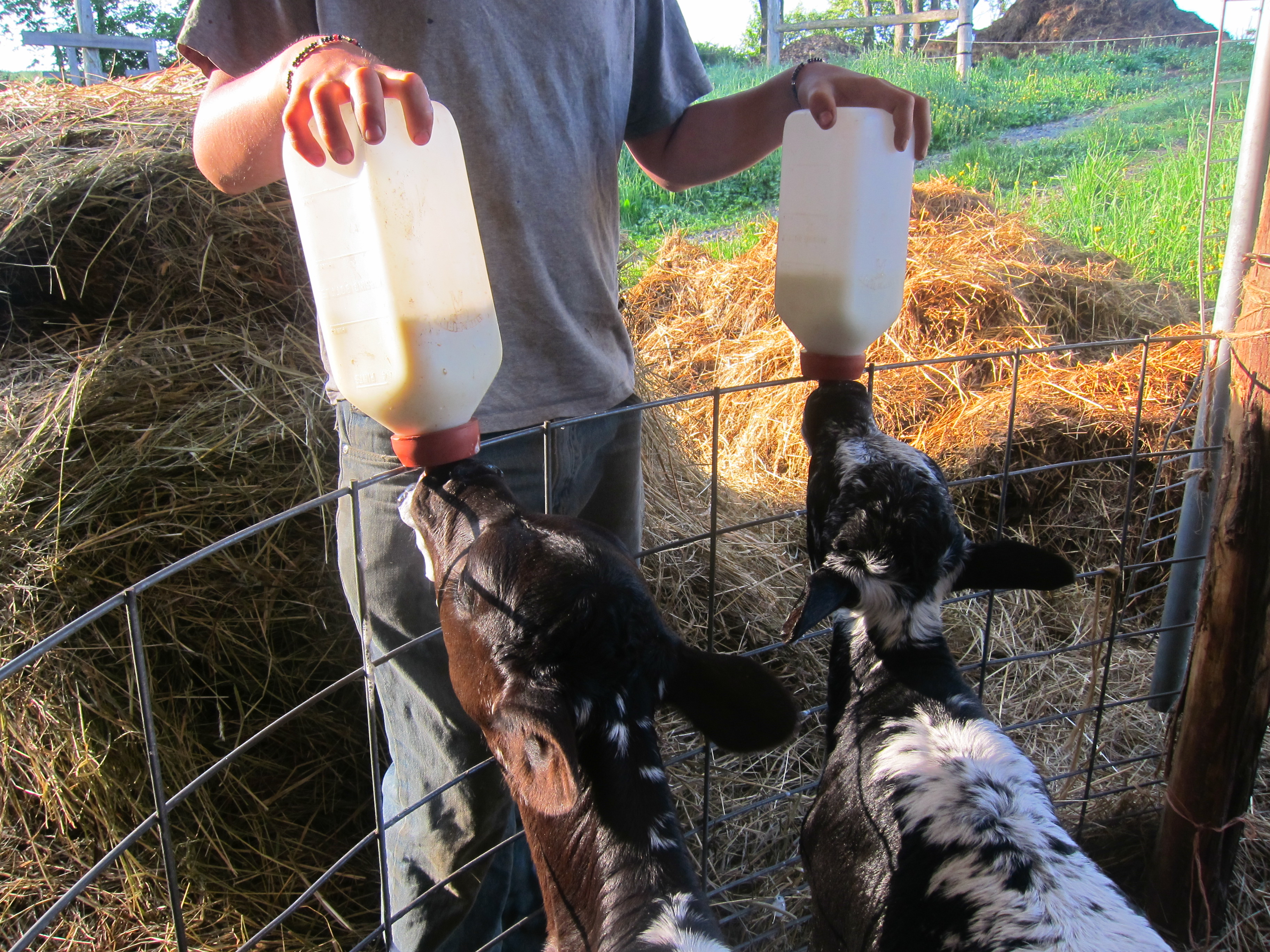
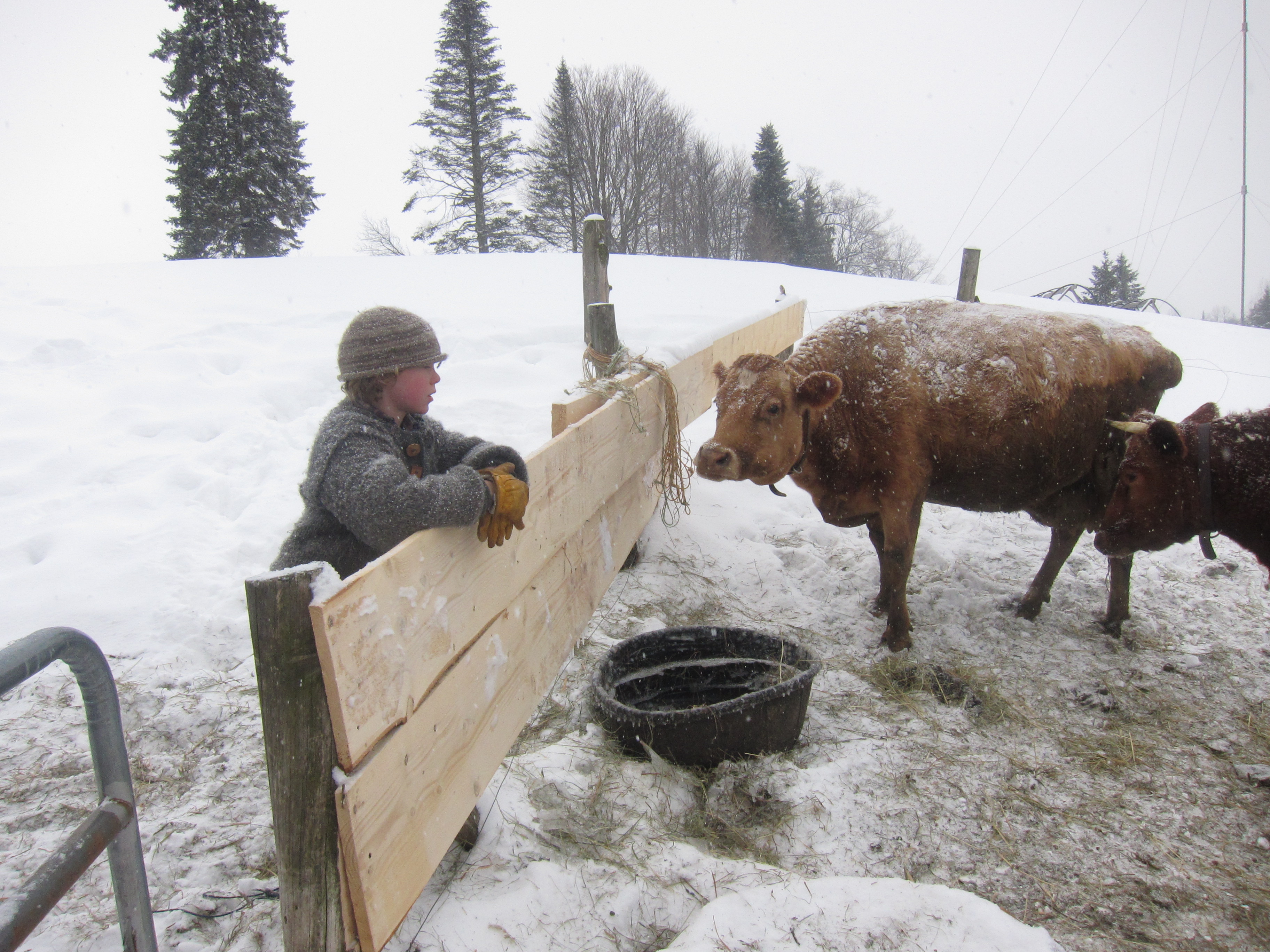
We are milking two cows, twice per day. We milk by hand, in a corner of our humble pole barn. For the past couple of days, we’ve milked to the patter of rain on the tin roof, and that’s been real nice. Penny does most of the milking, though I pinch hit from time-to-time. From beginning to end, including a mid-milking break to feed the calves, it takes about 40 minutes. We both like it. It’s not a burden, though obviously not for the uncommitted.
Milk is the cornerstone of this little operation. It makes our butter, our kefir, our soft cheese. It makes our beef and this year, with a beautiful heifer on the ground, perhaps it will generate a little income. We feed the skimmed milk to our pigs and they are kind enough to convert it into chops and bacon. Good piggies. Thank you.
Of course, our milk comes from our cows, so perhaps it’s actually the cows that are the cornerstone of this little operation. They make the milk, they birth the beef and heifer calves, they graze the grass, they give us something meaningful to do for 40 minutes at the beginning and end of each day. No small point, that last one. It’s actually pretty damn important.
Of course, the cows couldn’t exist without the grass they feed on, so maybe the cornerstone of this little operation is grass. Funny to think about, isn’t it? Grass. The prey of lawnmowers the world over, which is crazy, because it’s actually one of the most abundant perennial food crops in the world. You think you can’t eat grass? That’s nuts. Of course you can eat grass. You just gotta run it through the digestive system of a ruminant first.
Except, well, the grass doesn’t grow without the sun, the rain, the soil. So I guess I was wrong before: These are the cornerstones of this little operation. They make the grass that feeds the cows that make the milk that makes our beef and bacon and butter and (!!!) ice cream. You think you can’t eat sun, soil, and rain?
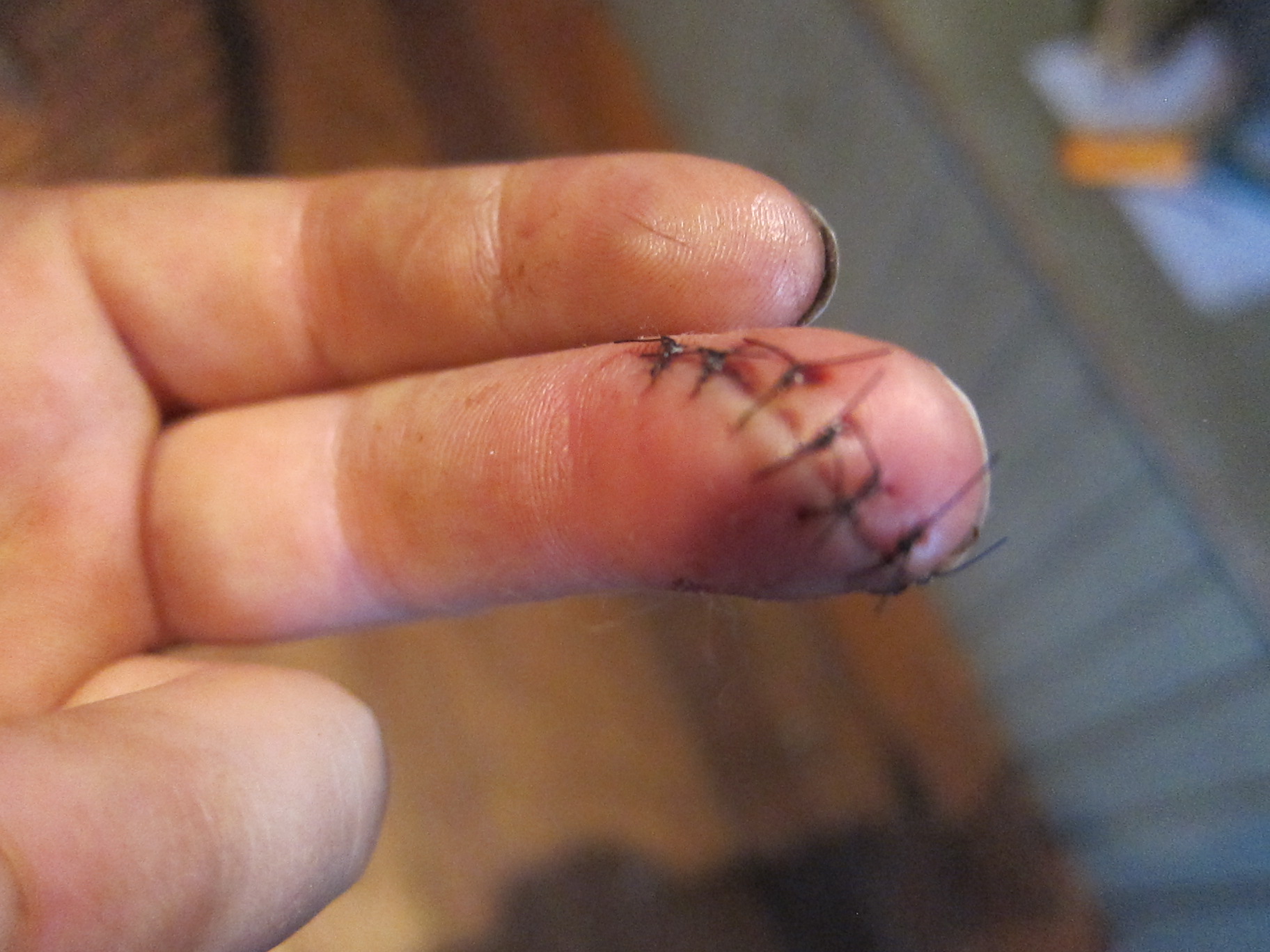
Sometimes a butterfly bandage just doesn’t cut it. Heh. “Cut” it… get it?
It’s nice that it’s a little warmer now. I dally over chores, stopping at each species to stand watch for a minute or two. I like watching the ducks drink after I chop through the ice in their watering hole. I like watching over the evolving relationship between Web, our pet duck who chooses barn life over communion with her kind, and Rye’s goats, Flora and Monkey. We moved Flora and Monkey from their usual winter shelter because the deep snow had made their fence superfluous, and they’d become prone to wandering.
Their relationship with Web did not get off on a good foot (hoof?): There were head-to-head standoffs between the duck and Monkey, and I’d have been worried if I didn’t know how fast that bird can move when it suits her. But at some point in the week after being introduced, the three made their peace, and now Web is forever preening her former adversaries, perhaps having decided that antagonism was getting her nowhere, and she might just as well annihilate them with kindness. The goats lean into her while she works her way up and down their backs with her bill. The goats are shedding in the changing season; the preening must feel good.
We’ve lived with animals long enough now that it’s hard to imagine a time we didn’t live with animals. I understand why most people don’t want to live with animals (I’m not talking about house pets, which for the most part are so adapted to the human environment that they demand relatively little of us); the commitment is not inconsequential. There’s no question that our lives are defined by our relationships to our animals, both in regards to our day-to-day comings and going, but also in how we perceive the world around us, and even how we perceive ourselves.
I thought about this yesterday, after reading Charles’ recent account of his encounter with a toddler. The piece spoke to me, in no small part because I understand full well what he means about grappling with criticisms both external and, most affecting to me, internal. I suspect this is a common phenomenon among writers or anyone else whose work exists in the public realm. Or maybe it’s straight up common to humanity. I also agree with Charles that part of the value of my work – it’s value to me, at least – is that I sometimes question its value. It is important, that questioning, the same way it’s important to occasionally question just about everything we think we know or believe. I have learned that the people most deserving of my trust and respect are not those who claim to have the answers, or who claim to know what answers I should have, but rather those who leave room in their hearts and minds for the possibility that the stories they cling to might not be as important as they believe.
Our animals do for me what the baby in Charles’ essay did for him: They remind me, on a daily basis, that my written work is merely one aspect of who I am, it is merely one medium for expressing what I think is important to me. And on those days when it feels as if I accomplish nothing else, they provide me the opportunity to know that at least I accomplished this: I fed them. I watered them. I tended to their needs. I stood for a moment and watched a duck preening a goat, something that only a few weeks ago would have seemed an unfathomable kindness between two arch enemies. I watched one cow stretch her rough tongue to scratch the hard-to-reach itch of another, and I wondered how this need is communicated. I stood over the pigs sleeping in their hay, their soft bellies rising and falling with each porcine breath, and I challenged myself to fill their trough without waking them.
I think these interactions – both between myself and our animals, and between our animals themselves – are worth more than any casual observer might understand. Perhaps worth more than even I might understand. Maybe because, as Charles posits, they are in some manner redemptive, almost an atonement for the myriad ways in which I fall short.
Or maybe they are worth so much for an entirely different reason: They are something that no amount of criticism, either external or internal, can sully. There is no viewpoint expressed, no belief espoused, no argument made, no position defended, no status to be attained or denied, and therefore, no ego to be inflated or deflated. There is not even a verbal acknowledgement of appreciation.
There is merely one creature meeting the needs of another, and the minutia of the interactions necessary to the task, so fleeting and routine that it’s easy to lose sight of their value. This is particularly true in a culture that does not acknowledge or even understand this value. For what is gained? I cannot show you. I struggle to even tell you. But I know it is real nonetheless.
Cold again this morning. I started chores early for no good reason than I’d risen early, and it was nice to be outside on the leading edge of daylight, the sky turning shades of pink and blue above me. Yesterday’s snowfall had obscured our bootways, and every third or fourth step I’d land wrong, slide off the packed path, and sink to the thigh. Set down the hay bale, the slop bucket, the water pail, heave out my leg, pick up my load, walk, repeat.
Rebecca Solnit has a nice essay in the new issue of Harper’s, called “Abolish High School.” Here is some of what she writes:
Suicide is the third leading cause of death for teens, responsible for 4,600 deaths per year. Federal studies report that for every suicide there are at least a hundred attempts – nearly half a million a year. Eight percent of high school students have attempted to kill themselves, and 16 percent have considered trying. That’s a lot of people crying out for something to change.
We tend to think that adolescence is inherently ridden with angst, but much of the misery comes from the cruelty of one’s peers. Twenty-eight percent of public high school students and 21 percent of private school students report being bullied, and though inner-city kids are routinely portrayed in the press as menaces, the highest levels of bullying are reported among white kids and in nonurban areas. Victims of bullying are, according to a Yale study, somewhere between two and nine times more likely to attempt suicide. Why should children be confined to institutions in which these experiences are so common?
Solnit’s question is rhetorical, but that doesn’t mean there isn’t an answer to it. Or many answers, probably, but for the sake of expedience, I’ll suggest only one: Because their parents can’t imagine something different. Part of the reason they can’t imagine something different is because they can’t afford to imagine something different. And partly, it’s because they’re afraid to imagine something different – in my experience, that fear is oriented primarily around their children’s social and economic prospects. In short, they worry that if they don’t send their kids to school, their kids will become outcasts with few prospects for gainful employment. Better to risk the bullying than the job prospects, and besides, at some point, kids have to learn that not everyone’s going to treat them nicely, don’t they?
But I also think many parents can’t imagine something different because they don’t know there’s something different to imagine. They are not aware there are other paths to walk. Because as Solnit also writes: High school is often considered a definitive American experience, in two senses: an experience that nearly everyone shares, and one that can define who you are, for better or worse, for the rest of your life. This is how the story of school has become so foundational; as adults, most of us have been defined by it, and we have come to depend on it to understand, at least in part, who we are.
Which begs the question: Who are we? Many things, of course. Far too many to list here. But among them, we are a culture that compels their children to be confined daily to a space where 28% of them are bullied. Furthermore, we are a society that comprises 4.6% of the world’s population, but consumes 80% of the world’s pain medication. Depending on age group and gender, nearly 25% of us take drugs to treat our depression.
When people read interviews with me and criticize what I have to say about education, I often wonder what they see in the institutionalized school system that is so worthy an alternative. Are they thinking of the 72% of children who aren’t bullied? I mean, hey, that’s a majority! Nice work. But what of the bullies themselves, if one can be so compassionate as to think of them? I’ve known a few bullies in my life; I even know one or two now. None of them seem very happy to me.
Or are they thinking of the economic opportunities they presume unschooled children won’t have? They are, or at least they say they are, and in a way, this makes me saddest of all, because it suggests that a child’s education should first and foremost be subservient to their economic interests.
Still, sometimes I wonder if the reasons stated for their opposition run even deeper. As Solnit writes, school has become a definitive part of the American experience. It is apple pie, it is Fourth of July, it is part and parcel of our faith that the story we’ve all grown up inside, the story we are all – to varying degrees and by varying levels of complicity -invested in is the right story.
As I went about chores this morning, stumbling and slipping along our well-worn boot packs, I was thinking about how our foot travel has mostly been limited to those prescribed paths for so long. And it occurred to me this morning how liberating it will feel to be able to walk where we please, as if, having been trapped in a labyrinth for all this time, we suddenly find ourselves at the exit.
Yesterday afternoon Penny and I spent a couple hours in the kitchen. We did a bunch of things. First we sliced up a pair of chuck roasts real thin for beef jerky. The trick to slicing meat thin enough for good jerky is twofold: A sharp knife and a partially frozen roast. Then we chopped up a whole lot of garlic – we grow way more garlic than we can eat, but we sure do try – and mixed it into some tamari and a little honey. Penny might’ve put something else in there, too… I’m not sure. It’s her recipe; I don’t ask questions. We put the sliced meat in a bowl, poured the marinade over it, and stuck it in our passively vented icebox for the night.
When we finished slicing the meat, I went to the basement and dug a few carrots out of one of the burlap bags in the basement. This winter, we experimented with storing our carrots in dead leaves, and it’s worked out pretty good. We raked the leaves off the paths in our neighbor’s sugarwoods. I remember the boys jumped and wrestled in the raked up piles and I thought I should join them but I didn’t. Still, it was fun just watching them. I took the carrots upstairs. Washed them. Peeled them. Cut them small for stew.
I had some chunks of venison browning in lard on the wood cookstove. It smelled good. Earthy. The lard was from the pigs we slaughtered in January; the meat was from a fat little roadkill doe Fin and I came upon last fall, ironically just after we’d gotten home from rifle hunting. I would tell you how many roadkill deer we’ve harvested in the past six years or so, but it’s such an outrageously high number you’d never believe me and I’d only look like an idiot for having tried to pull the wool over your eyes (even though I didn’t). So let’s just say we haven’t gone without venison in a real long time, none of which were killed by our own hand or (thankfully) even our own vehicle. Sometimes I think it’d be cool to spend a year just living off roadkill and wild greens. But… nah.
While we worked, Penny and I got to talking about some things we’d heard on the radio. We generally listen only when we’re driving solo, and we’ve each been driving too much lately, so we had lots to talk about. She told me about some fellow who’d done a segment on his new coffee maker, which apparently communicated with his smartphone. I guess the way it worked is that the coffee machine would actually call him when it needed tending. Sort of like an aging parent or a teenage child, I said, and she laughed, and I was pleased, because in my experience there’s not much better than making someone you care about laugh, especially if she generally finds your jokes lacking. Anyhow, I digress.
I told her about something I’d heard that very morning, about how the cereal makers are in big trouble. No one’s buying Cocoa Frosted Death Flakes anymore, and I thought for sure they were gonna say it’s because people are finally getting wise to that shit, but lo-and-behold it was for a much more pedestrian reason: People want something more convenient than cold cereal these days. In other words, it’s too much work to pull the box and a bowl out of the cupboard, the milk out of the fridge, and a spoon out of the drawer. It’s too much work to “prepare” a bowl of cold cereal – the pouring of the flakes and the milk is simply too great a drain on the precious commodities of time and convenience. And then all those dishes to wash! So what’s the next big thing? Breakfast bars, apparently, because you can eat them in the car on your way to work. Tear open the package with your teeth, stuff your gullet whilst navigating traffic (it’s a pain in the ass, I know, but don’t fret: Driverless cars are coming soon!) and then stick the empty wrapper under the seat with the cast off detritus of previous breakfasts. Or maybe just throw it out the window. Yeah. That’d be even easier.
A story to ground all this: About a decade ago, we ripped the propane cookstove out of our kitchen and replaced it with a wood burner. I recall being a little anxious about the amount of work I perceived to be involved with cooking on wood. No more would I be able to twist a dial and have blue flames leap at my command. Now it was fell the tree, buck the log, split the wood, stack the wood, haul the wood inside, crumple the paper, lay the kindling, strike the match, feed the fire. Then coffee. Then breakfast. It all seemed like a bit much at the time, though clearly there was something about it that called to me.
Another story: A few years back, we turned off our gas-fired hot water heater. Let me be perfectly honest: This was no great hardship – we have solar collectors and a rather ineffectual loop through the wood cookstove – but it still means there are large swathes of time when we do not have hot water at the tap. Want to do dishes? Do ‘em in cold water, or heat some on the stovetop. Want a bath? Heat in on the stovetop (but mind the step!). And so on. As with the installation of the wood cookstove, I remember being a little nervous about extinguishing the pilot light in the water heater. As with the wood cookstove, I hardly remember that we ever had it differently, and now we burn only a couple dozen gallons of propane each year to fire the gas range we ripped out of the kitchen and stuck on the porch for use in the summer months. Honestly, I can’t say I’m more happy now that we don’t use our propane water heater, but I do experience a smallish delight in knowing how well we can live without it.
What’s my point? Actually, I think I have something like a half dozen points, though I may not get to them all. The first is that convenience (or the lack thereof) is almost 100% relative and almost 100% unrelated to happiness. When we lived without any plumbing at all, which we did for years while saving for this land, we thought running cold water would be the pinnacle of convenience (we didn’t even dare dream of hot water at the tap, lest we anger the gods with our greed). Funny thing is, we weren’t any less happy then than we are now.
Point number two: In far too many cases, without us even knowing it is happening to us, convenience sucks the simple pleasures out of our lives. I’m thinking of my boys wrestling in those piles of leaves I inconveniently raked in order to inconveniently store the carrots we inconveniently grew. I’m thinking of this morning, as I sat by the cookstove fire, writing the first half of this post and waiting for my coffee to perc. I’m thinking of splitting wood, the way my body feels after a day with the maul. I’m thinking of how that beef jerky is going to taste, I can smell it now from my office; Penny must have spread it across the drying racks. It’ll be ready by tomorrow morning, I bet. I’m thinking that Erik’s going to be here for lunch and we’ll eat venison stew from a deer my son and I hoisted into the back of our Subaru and butchered on our kitchen counter. Even at the time, I remember feeling a little put out by the inconvenience of it all: I’d had other plans for the day. But now I don’t remember what they were.
Point number three: I’m thinking that appeals to our desire for convenience are actually nothing more than sleights-of-hand intended to further ensnare us in the sticky web of consumption. And in doing so, furthermore erode our ability to care for our communities and ourselves. For what skills do these conveniences require? Only the skills necessary to maintain the jobs necessary to pay for them. To plug them in, to rip open the packaging with our bare teeth, one hand still on the wheel, weaving in and out of traffic, perhaps recalling that once upon a time we actually had to eat from a bowl, and oh! How wonderful it is to have been freed of that burden.
Last night, I noticed a spike in my traffic. Ever curious, I traced it to a comment someone had left on Mr Money Mustache. I’d never heard of the dude, but from my cursory examination of his blog, I’d probably like him. For instance, he’s big into badassity, which seems real similar to something we’re into. Furthermore, he writes with enviable cogence and wit about money and all things associated, albeit from the perspective of radically different lifestyle choices.
Indeed, the specific piece of his that prompted the comment linking to this space was about education, called “If I ran the school, things would be different,” and it got me thinking a bit this morning about what my school would look like, were I to be so naive as to embark upon such a venture. Which I’m not, so don’t worry: The children of America are safe from my nefarious influence. Well, all but two of them, anyway.
Without further ado, inspired by MMM, my version of “If I ran the school, things would be different,” which I have taken the liberty of retitling “If I ran the friggin’ school, you can better friggin’ believe things would be real friggin’ different. Got that?”
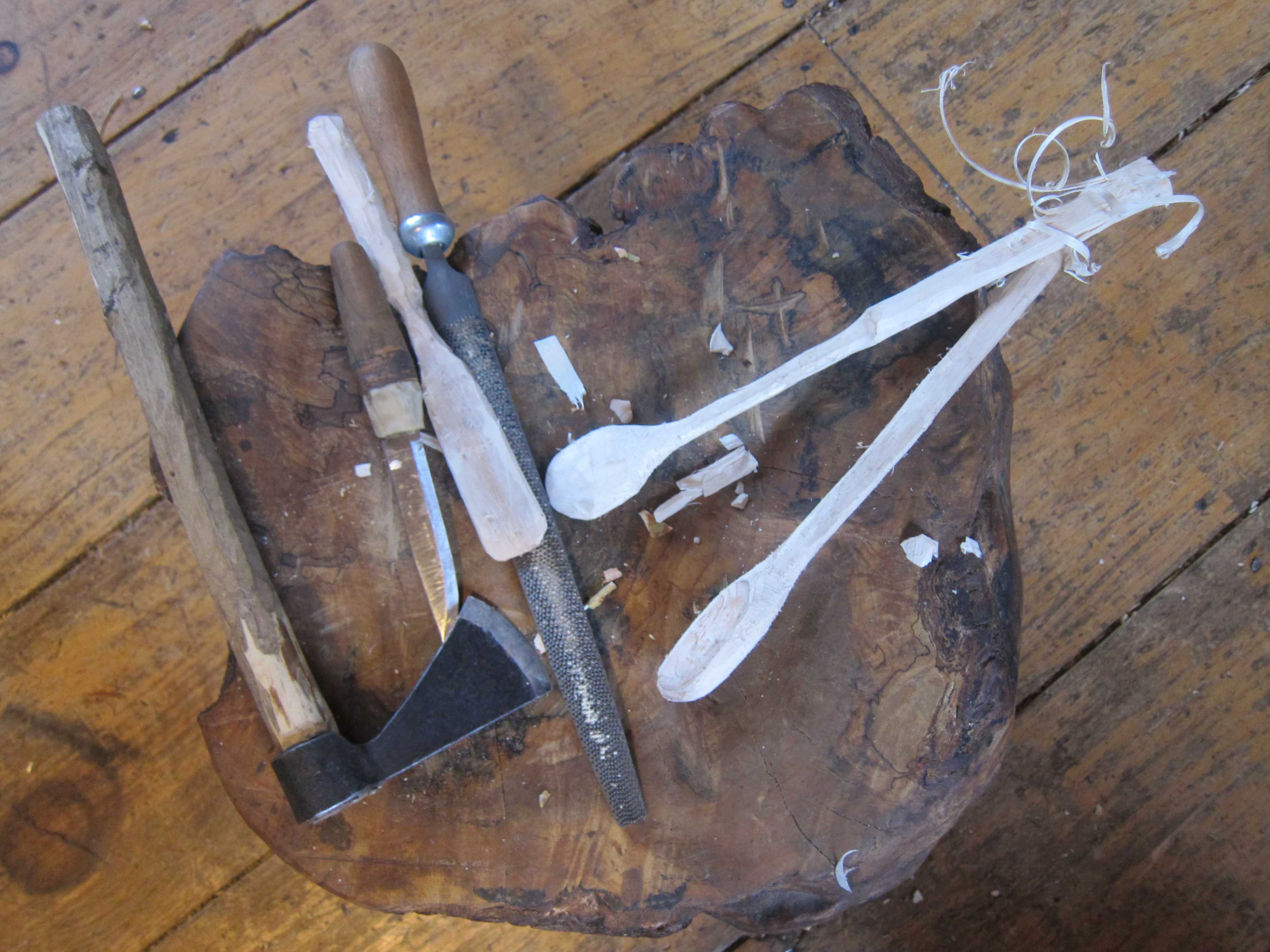
1. If I ran the school, incoming students aged 5 and above would be issued a fixed blade belt knife, a sharpening stone, and a box of bandages (We actually gave our boys knives at age 4, but I realize that’s maybe a wee outside most parents’ comfort zone). Why a fixed blade belt knife? Well, for one, because folding pocket knives are actually far more hazardous, and for two, because proper knife handling is one of the most liberating and useful skills a child can have. Why a sharpening stone? Because dull knives are dangerous knives. Why a box of bandages? Because hell yes, they are going to cut themselves, and being taught how to doctor their own wounds is yet another incredibly useful skill that almost no children learn these days.
2. If I ran the school, every classroom would have doors and windows that opened to the outdoors, and every bit of wall space that wasn’t comprised of doors and windows would be filled with books. Thin books, fat books, comic books, classic books. Books upon books upon books upon friggin’ books.
3. If I ran the school, classes would not be age-segregated, and younger students would likely spend as much – if not more – time learning from older students as they did from “teachers.”
4. If I ran the school, children would learn how to cook before they learned calculus. Actually, they’d start learning how to cook before they learned addition and subtraction. Actually, they’d learn addition and subtraction as they learned how to cook. Actually, they’d already have learned addition and subtraction while determining how much garden space they needed to grow the ingredients they’d use to feed themselves.
5. If I ran the school, students would spend more time outdoors than in. But you knew that.
6. If I ran the school, every child would learn how to use basic hand tools. They would use these tools to build a shelter in which they would spend the night. In winter.
7. If I ran the school, there would be lots and lots of toys in every room. These toys would look suspiciously like sticks, rocks, scraps of fabric, paper, paints, and other found objects. There would be no legos. There would be nothing that lit-up and beeped, unless the children were clever enough to make something that lit up and beeped. There would be none of these ridiculously overpriced natural wooden toys that any child with half a brain, the right tools, and the weeniest bit of facilitation can damn well make for themselves.
8. If I ran the school, there would be instruments in every room. Guitars, hand drums, and pretty much everything but accordions and nose flutes (don’t ask). These instruments would be inexpensive and well-used, so that no one would be tempted to tell the students to “be careful.” No one would say “don’t play it like that.”
9. If I ran the school, the primary economics text book would be Charles Eisenstein’s Sacred Economics. The primary history/sociology text books would be Daniel Quinn’s Ishmael and My Ishmael . Meanwhile, the dangers of drug use, casual sex, and excessive rocking-the-fuck-out would be demonstrated via exposure to Motorhead and repeated viewings of the movie Lemmy.
10. If I ran the school, there would be a bicycle for every child. If the school I ran were in a four-season climate (and it would be, because I’m not moving out of a four-season climate just to run a school), there would be cross-country skis for every child.
11. If I ran the school, I would not talk about how my students are more likely to gain admittance to the college or university of their choosing than conventionally-schooled children, or about how the skills, curiosity, and resourcefulness my school engenders will make them more suited to the contemporary job market. Because while these things might well be true, they are not the point!
Which is probably why my school would not be very large.
Back in high school I spent a lot of time with my friend Jim. Jim was a few years old than me. He had an old Saab he’d bought cheap and we liked to drive around listening to music and maybe smoking a little weed. I said “maybe” and “a little,” ok?
Anyway. Back then, we mostly listened to Rush. My favorite Rush album was (and remains) 2112. I guess you’d call 2112 a “concept” album, or at least the first half of it, which consists of an uninterrupted 20-minute expanse of music that tells of a dystopian future in which a commoner stumbles upon an acoustic guitar long after such instruments have been judged frivolous and thus jettisoned somewhere between now and then.
The lyrics begin like this:
“We’ve taken care of everything/the words you read the songs you sing/the pictures that give pleasure to your eye/It’s one for all and all for one/We work together common sons/never need to wonder how or why.”
I liked 2112 so much, I think, because it fit my worldview at the time, which was largely oriented around an acute sense of disempowerment related primarily to my schooling. (It’s probably telling that another of my favorite songs was a Bad Brains number called The Regulator, a one-minute, seven-second hardcore punk riff on, well, being regulated). This is how I described my relationship to high school in Home Grown:
Did I hate school? Well, yes, I suppose so, but only in aggregate. There were elements of it I liked very much. For instance, I liked hanging out in the parking lot with my friends. That was a lot of fun, or at least, it fit my version of fun at the time. I liked Creative Writing, one of the few classes I rarely cut. I liked my physics class, not because I liked Physics (I flunked it, along with Algebra, Calculus, History, and French) but because Tom, my teacher, was something of an oddball. He smelled horrific, wearing the accumulation of his fetid perspiration like a badge of honor. But despite the odor, and despite my flailing half attempts to succeed in his class, there were compensations, such as the time he encouraged my friend Django and me to paint an old steel barrel with the international warning symbol for nuclear waste and leave it in a conspicuous place on school grounds. In no way could I discern how this had anything to do with physics.
“Why?” we asked him.
He raised his walrus-ian eyebrows into inverted V’s. “To see what happens,” he replied.
We jettisoned the barrel in a shallow depression at the edge of one of the playing fields, after which followed a sleepless night listening to the Bad Brains and fretting over the legal ramifications of creating counterfeit toxic waste. What special sort of wrath might the law reserve for a couple of sixteen-year-olds with an old barrel, a can of spray paint, and an ingrained sense of mischief? At two thirty a.m., in the lonely darkness of my childhood bedroom, my imagination ran toward long years of solitary confinement in the sort of juvenile facilities that are, at some point in the distant future, revealed to have been riddled with abuse.
The following morning, the barrel was gone. Django and I waited anxiously for news of its discovery, but none came, and for reasons I still do not understand, this delighted Tom.
Despite these shenanigans and despite the pleasure I derived from my creative writing class, the prevailing theme of my truncated high school career was one of simple boredom. And with it, a sense of my time being wasted, of my life slipping through my young fingers. In class after class, I slumped in my chair, quietly seething at my captors and, more broadly, at the unquestioned assumption that I should be held captive in the first place. Where was the relevance in what I was learning? In what ways might it inform and improve my life outside the context of school? It felt to me as if the entire experience was unfolding in a vacuum and that, once I graduated, the seal on the vacuum would burst, and I would be helplessly sucked into the real world, for which my schooling had done little to prepare me. I think this feeling frightened me, although I doubt I would have admitted so at the time.
Restlessly, I would shift my gaze from the algebraic equations scrawled across the chalkboard to the fields and forest and sky that for the majority of my waking hours remained achingly out of reach beyond the classroom’s plate glass windows which, for all their transparency, felt like nothing so much as the bars of a prison cell. What was I looking for? Nothing in particular, frankly. Nothing more than simple escape, a refuge from captivity, where the information I was being forced to memorize and recite (as if the latter were proof of having learned something) felt as if it mattered only against the backdrop of school.
Again I must return to the article I quoted from a few days back:
Education and upbringing is a hallmark example of the extent to which the system of control has saturated our lives, bodies and minds. We do not realize is how extensively our way of seeing the world and more importantly; how we see ourselves in it, is a direct result of our upbringing and education. As Ivan Illich, the author of “Deschooling Society” puts it: “School is the advertising agency which makes you believe that you need the society as it is.”
I think Illich is precisely right in the above quote: School is the advertising agency which makes us believe that we need the society as it is, and it is incredibly effective precisely because so few parents (but interestingly, maybe not so few children) recognize this. I wonder if this is ultimately why I felt so disempowered by it: It was trying to force me to accept a view of myself, the world, and the confluence of the two that did not jibe with what I felt and understood to be true. I also wonder if this is why some people are so threatened by the notion of children being reared in the absence of compulsory “learning”: It is not merely a repudiation of their views on education, it’s a repudiation of their views on life.
Or – and I’m guessing this might be closer to the truth – maybe they’re so threatened precisely because on some level, they do recognize the extent to which the system of control has saturated their lives. They recognize it, but it is simply too frightening to acknowledge. They are too immersed it in to see a way out, and therefore, they will do whatever they can to make themselves comfortable within its confines. I guess maybe we all do this to a certain extent, no?
Even among those parents who do see the messaging implicit to compulsory institutional education, fewer still have the luxury of choosing differently. Or maybe they are simply too afraid for their children’s economic futures to choose differently – I’ve heard some variation of this theme from numerous parents. I know it’s not great, but how else will he get into college? Who will hire her? Etc, etc. Pragmatism over passion, though I suppose the two needn’t always be mutually exclusive.
For those of us who have chosen a different path, the challenge is that we forever exist on the fringes. For most families, school creates a default community. It offers a way to pass the days, a place for children to go while parents are working or otherwise engaged. This I hear a lot, too: I’d love to homeschool my children, but I could never spend that much time with them. That’s what I was thinking of yesterday when I wrote about working alongside, talking to, and learning from our children. That’s not something many parents know how to do these days. I know I’m still figuring it out. But my point, really, is that by opting out of school, you’re not merely opting out of school, and whether you believe that is for the better or the worse, it is no small thing.
I am meandering, now, losing sight of my message, so I guess I’ll pull the old writer’s trick of circling around to the beginning, running in that old Saab with Jim. As you know, I dropped out of school, while Jim went on to a technical college, before ultimately founding a solar installation business. He was smart enough to see what school could offer him, the stuff he needed to know to do the stuff he wanted to do. I don’t think he felt as trapped or disempowered as I did. It’d be interesting to ask him about it now, but I can’t, because he died a few years ago. His heart just up and quit while he was sleeping.
A few months before he died, Jim invited me to a Rush concert in Saratoga Springs. I demurred, so his wife went with him instead. They had a great time, and though there’s part of me that wishes I could claim the memory of my friend and me at the concert, pumping our fists and singing along to 2112, there’s another part of me that figures his wife deserves to remember that at least as much as I do.
The storm was lesser than forecast. We got maybe three inches of snow, though by this morning the wind had deposited it into sharp-ridged drifts. I pushed through two of them on my way to the barn this morning, both knee-deep, the snow soft and yielding. It was zero, but the early light – thin, uncertain, sunless -made the air feel even colder, and by the time I returned to the house, my fingers stung. I shucked my gloves and held my hands over the hot iron of the cookstove, flipping them every dozen seconds or so until the cold was all burned out.
• • •
A few steps of the dance, performed just three or four days a month, enriched their lives greatly and took almost no effort. As here on earth, the people of this planet were not a single people but many peoples, and as time went on, each people developed its own approach to the dance. Some continued to dance just a few steps three or four days a month. Others found it made sense for them to have even more of their favorite foods, so they danced a few steps every second or third day. Still others saw no reason why they shouldn’t live mostly on their favorite foods, so they danced a few steps every single day. Things went on this way for tens of thousands of years among the people of this planet, who thought of themselves as living in the hands of the gods and leaving everything to them. For this reason, they called themselves Leavers.
But one group of Leavers eventually said to themselves “Why should we just live partially on the foods we favor? All we have to do is devote a lot more time to dancing.” So this one particular group took to dancing several hours a day. Because they thought of themselves as taking their welfare into their own hands, we’ll call them the Takers. The results were spectacular. The Takers were inundated with their favorite foods. A manager class soon emerged to look after the accumulation and stores of surpluses -something that hand never been necessary when everyone was just dancing a few hours a week. The members of this manager class were far too busy to do any dancing themselves, and since their work was so critical, they soon came to be regarded as social and political leaders. But after a few years these leaders of the Takers began to notice that food production was dropping, and they went out to see what was going wrong. What they found was that the dancers were slacking off. They weren’t dancing several hours a day, they were dancing only an hour or two and sometimes not even that much. The leaders asked why.
“What’s the point of all this dancing?” the dancers asked. “It isn’t necessary to dance seven or eight hours a day to get the food we need. There’s plenty of food even if we just dance an hour a day. We’re never hungry. So why shouldn’t we relax and take life easy, the way we used to?”
The leaders saw things very differently, of course. If the dancers went back to living the way they used to, then the leaders would soon have to do the same, and that didn’t appeal to them at all. They considered and tried many different schemes to encourage or cajole or tempt or shame or force the dancers into dancing longer hours, but nothing worked until one of them came up with the idea of locking up the food.
From My Ishmael, by Daniel Quinn. I highly recommend it.


 Ben Hewitt