Some Things Do Indeed

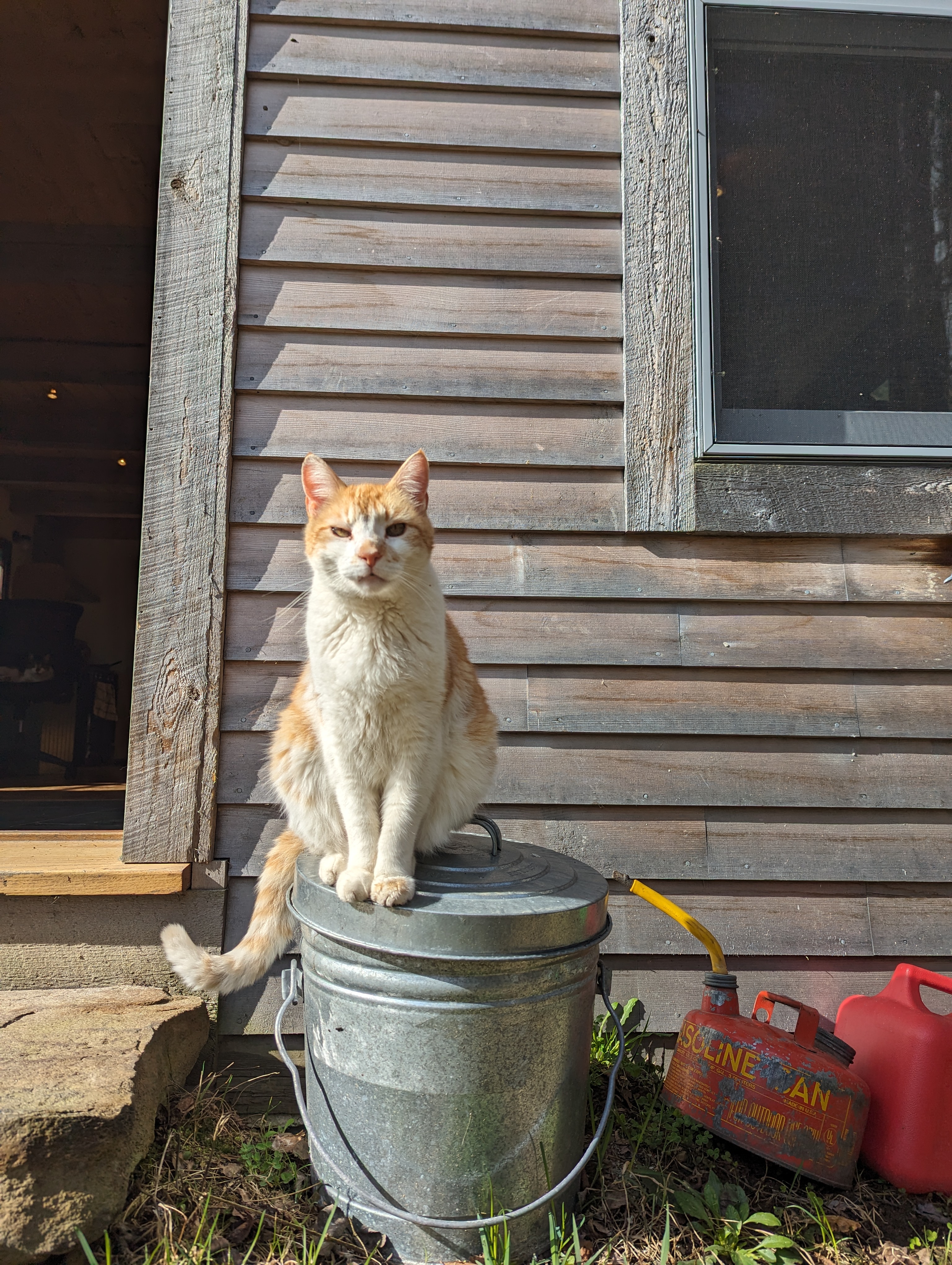
In the morning I awake to tendrils of cold pushing through invisible cracks at the edges of the window sash above my head. Even with the outside air hushed and still – the limbs of the trees unruffled, the wide expanse of sky parked in place like a stolid, immovable stone – the cold feels driven, as if exhaled from the depths of lungs hidden deep in the earth or lurking behind the granite facade of that overly serious sky. The cat dozes by my head. He has two teeth, a pair of rheumy eyes, and an assortment of scabs that I try not to pick at. He’s 16 but I’m thinking I can squeeze another five years out of him. Well. Four, anyway.

You’re wondering where I’ve been. Or maybe you’re not, but if you were, fair enough. And if you were wondering, my apologies for the disappearing act. It wasn’t planned but as time went on, I found that it only got easier and easier to remain mute, as if silence were a muscle that gets stronger with use. And maybe it is. A friend reminds me of something I said to him years ago, back when I was fat with words, smug and satisfied in my productivity. The more you write, the more you write, is what he says I said, and I’m pretty sure that what I was trying to articulate is that the more you write, the more you’re inclined to write, there’s momentum to it and maybe habituation to the pleasure of putting words together in particular ways. And if it’s true that the more you write, the more you write, it only stands to reason that the less you write, the less you write Until you’re writing nothing at all.

Silent or not, life moves on. I meet a woman – a mother, a librarian, a writer with a wit as quick and sharp as lightning and a laugh that somehow reminds me of rain on a roof though it sounds nothing like that at all – and move 50 miles south into a farmhouse at the end of a dirt road in the steep hills outside a town that seems large to me only because with 1200 residents it’s six times the size of the one I left. I bury one of my cats amidst the intertwined roots of a sugar maple after he goes outside to lie in the sun and doesn’t get up. I fly west to visit my son and early one morning we drive into a small town so he can pick up some horseshoes because he has some horses to shoe. Not for the first time (and surely not for the last) I see how the arc of his life has broken into its own orbit and that whatever gravitational pull this boy feels (if at 21 he feels any at all) is not one I can – or even should – try to influence. Then my other son heads west, too, and I guess I didn’t even realize (stupid! stupid! stupid!) how profoundly this would shake me, these two men whose small, slippery bodies I used to bathe in a tin tub by the wood stove before pressing them against my chest to sleep, now launching into their lives with hardly a glance in the rearview to see how their old man is accommodating to their absence. Good Lord. Kids these days. No manners at all.

But that invisible cold. So familiar. So insistent. I lie in bed letting it drift over me. Thinking to myself that even though everything changes, some things do indeed remain the same.

I’ve read a lot of good books over the past year, but none better than this one, by my fellow Vermonter Nathaniel Miller. I highly recommend it.

I’ve listened to a lot of good music over the past year, and I’m particularly enjoying this song by the Delines. Slightly different vibe, but also loving the Droptines a whole lot.

Finally, I’m hosting a book discussion on one of my all time favorite books, The Light Pirate by Lily Brooks Dalton (who also lives in VT if I’m remembering correctly), this coming Monday, 3/23, at the Chelsea Public Library through the Vermont Humanities Vermont Reads program. You should come.

I Guess That’s OK With Me

Early morning on Dead Moose Pond

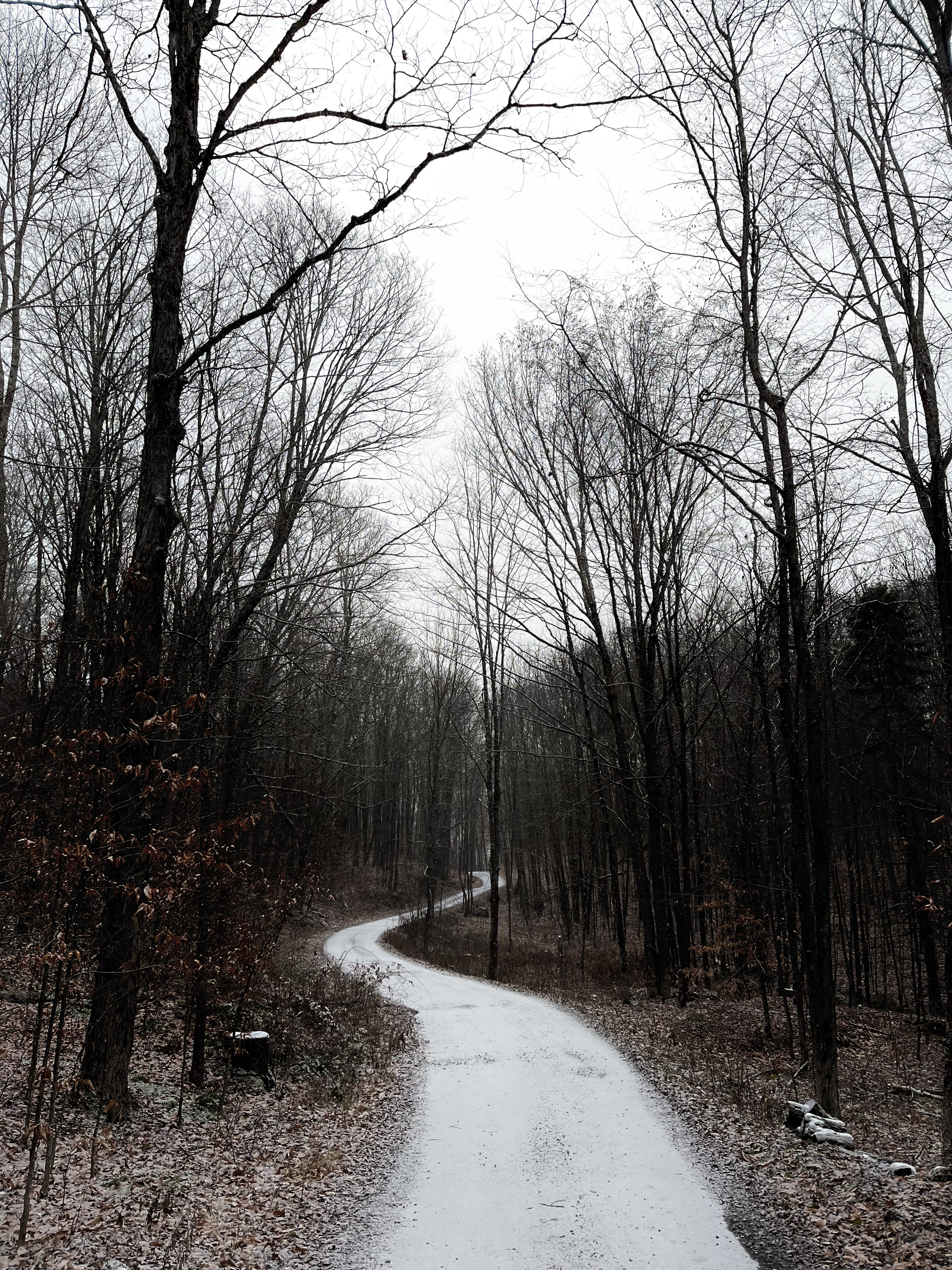
In the morning the temperature is a single degree above zero. Snow is falling, but the flakes are small, as if stunted by the cold. The cats lie immobilized by the wood stove, their long, heat-hungry bodies splayed across the hearth. I drive up the mountain at the break of day, the road striated at regular intervals by shallow drifts of windblown snow that make barely audible whumping noises as I pass through them. There are few houses along this stretch, and I do not see any other travelers, and their absence, combined with the cold and the wind and the uncertain light of this in-between hour allow me to imagine that I am careening into a desolate land, where safe passage is hardly guaranteed. And perhaps, in a way, I am.

At the road’s crest, I bind myself to my skis and angle toward the forest, where the wind is most forgiving. Even still, I am compelled to stop at regular intervals to swing my arms in exaggerated half circles, forcing hot blood into the tips of my numbing fingers. I know my body well enough to know that I’ll need to do this four or five or maybe six times before I’ve crossed the unprotected expanse of Dead Moose Pond and the trail pitches upward and my heart picks up its pace.

If I hurry, I’ll have just enough time to make the top of the mountain, which is the namesake of the small town situated along its western flank, the very one I live in. Yet there is no marked trail to its summit, and no real way to determine exactly when you’ve arrived there, unless you know to look for the little jar that hangs from the little beech tree that someone – I don’t know who, I don’t know when – decided would be the place. There are scraps of paper in the jar, and a dull pencil, and sometimes I sign my name and sometimes I don’t. Sometimes, I open the jar and just leaf through the paper scraps, curious to see who else knows this place or has found it by happenstance. There are some, though not very many at all, and I guess that’s ok with me.

By the time I return to the car, the temperature has risen to 3, and even along the open corridor of the mountain road, the wind has quieted. It’s still snowing, and if anything, the flakes seem even smaller. So small it’s hard to even be certain they exist.

What Happens Next

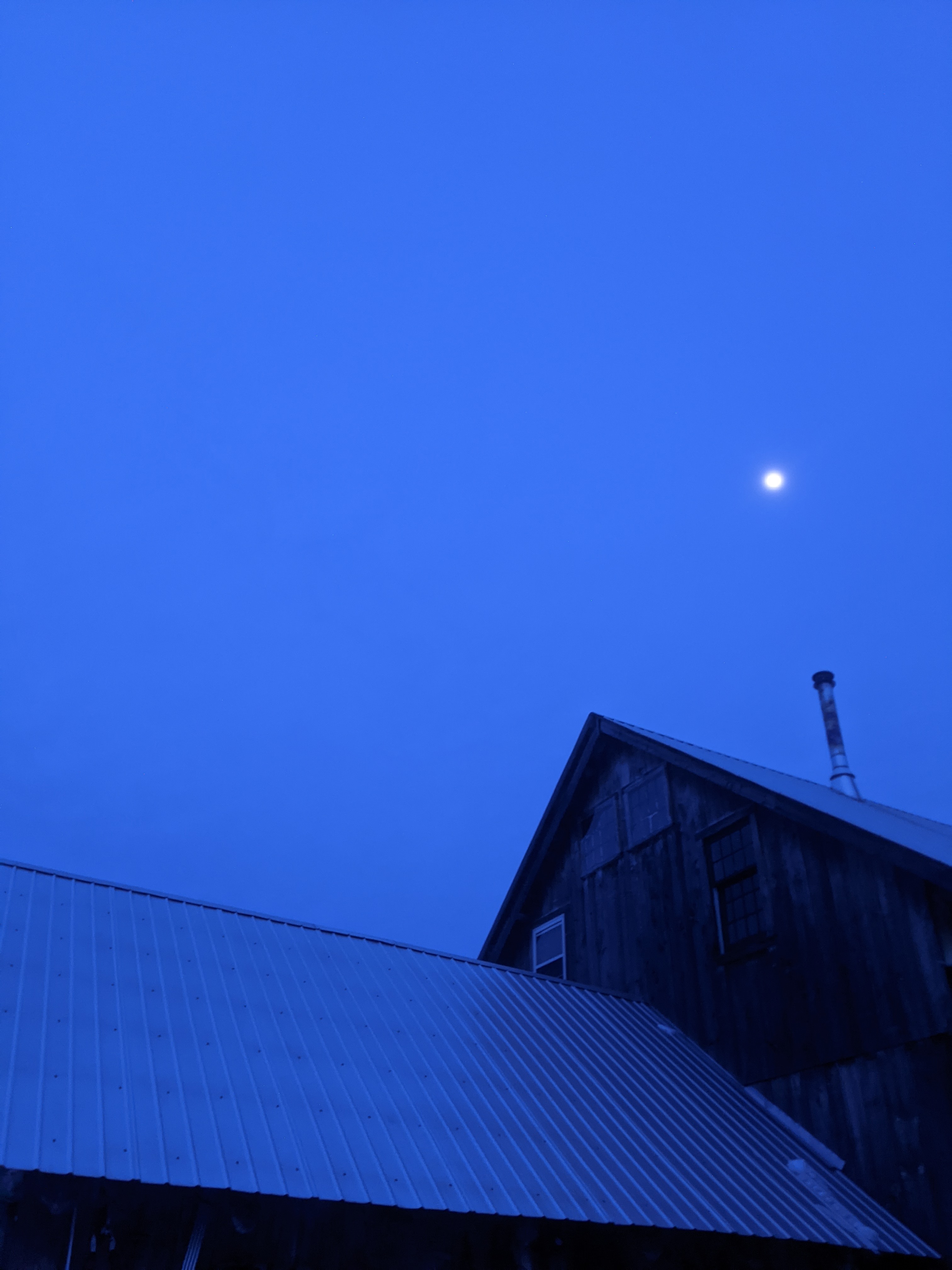
In the evening after dinner I walk up Silver Road, under a moon so bright it cast shadows at my feet. It’s unseasonably warm, and when the breeze blows, there’s the sound of rain pattering. Yet the sky is cloudless, and I puzzle over this for a moment until I realize that I’m hearing the small, dry rattle of falling leaves landing atop those that have fallen before. It’s hard to believe it’s almost November. It’s hard to believe winter will ever come at all.

Dean* passes me in his big, white truck, trailing – as he always does – the unmistakable odor of marijuana smoke. Dean’s a logger, and he’s built like one, short and stout and strong, and he tells me his doctor says he’s in real good shape for a man his age, which if I had to guess, is probably a year or two on either side of 60. He used to have a dog that looked just like him (or maybe he looked just like his dog, it’s hard to say, really), but that dog got hit by a car and died and now he has another one that doesn’t look much like him at all, though I suppose it could still happen. Sometimes these things take a little time.

I turn back where the road dead ends. When it’s daylight, I can see all the way to Caspian Lake from here, where the summer people host late afternoon cocktail parties with fancy cheeses and imported olives arrayed across beautiful lacquered cutting boards. Or at least, that’s what I imagine they do. Up here, the landscape is more open, the trees are set far back from the road, and I can no longer hear the falling leaves. A dog barks; another answers. Now the moon is behind me, and my own shadow lies long across the road. It’s just the vaguest likeness, though I’ll be damned if I don’t recognize the particular slant of my shoulders, the way they always seem bent a little forward, as if they’re in some sort of hurry to see what happens next.

*Some names in this story have been changed

Really digging this song by Ritch Henderson. Maybe you’ll like it, too.

A Force Beyond My Control

After the rain

A year to the day since the great flood of ’23, and the rain sweeps in again, hammering down for hours in the night, and when my phone rings at 4:00 a.m., rousing me from a dream in which I’m riding in the bed of a pickup piloted by an unknown woman who steers with a single, heavily bejeweled hand, I know it has to be bad.

It is bad: The bridge above the Rich’s is gone, the bridge at the bottom of the Mountain Road is gone, the Mountain Road from just past the Giles’ old place and upward is gone, Silver Road is reduced to a single lane, the lower section of Gonyaw is unpassable. And those are just the worst parts.

I drive the dangerous, diminished roads of my town in the dark, a pile of Road Closed signs in the back of my car, windshield wipers slapping, window open to the thick air, rain slanting through the opening onto my arm, into my lap, and I don’t even try to stop it. There seems no point to it. I’m already wet. The damage is already done. At 5, I find Kyle at the end of Norway Road and we travel the remaining roads together, stopping every so often to chat with whomever we meet coming the other way, all men, all in trucks, all wearing baseball caps, all greeting us with a smile and a rueful shake of the head, because while there’s nothing funny about any of it, there is a certain dark comedy at play. I mean, seriously, a year to the day of the previous flood, our little town still hundreds of thousands of dollars in debt from that storm, with the long-promised FEMA relief still dangling like a carrot at the end of the longest damn stick you’ve ever seen? Are you fucking kidding me?

Indeed, you are not.

And I don’t know what gets me thinking about this, maybe it’s just the vulnerability of the moment, the sense of being at the mercy of forces beyond my control – natural forces, bureaucratic forces, forces I cannot name and perhaps are not even nameable in any language I know – but all I can think about is the moment exactly one week prior when I’d left Rye standing in the middle of the vast Montanan valley where he now lives, on the vast Montanan ranch where he now works, after a too-short visit that had seemed shorter still, and for the entire three-hour drive to the airport where I’d soon fly 2500 miles in a direction pointing away from my son, I’d felt as if I might literally not survive. As if my love for him could break me into pieces too small, too numerous, too complicated and messy to ever be put back together into anything resembling their original whole.

Even though I thought this might actually come to pass – indeed, I was nearly convinced of it – and even though many times I thought to turn back, I also knew that I wouldn’t, that his life and mine have diverged in the ways they were always meant to. Which is not to say that we are not still connected, or that our lives won’t intersect again, because surely they will. But it is to acknowledge that he himself has become like the weather: A force beyond my control.

So instead of turning back, I kept driving under that ceaseless sky, putting mile after mile after mile between us. Waiting to see if maybe I’d survive.

The Matter at Hand

Early morning on the Mountain Road

In the morning I ride up and over the mountain just as the mist from the previous night’s rain is beginning to burn off under a rising sun. I pedal up and over the mountain at least one morning each week; it’s one of my three preferred morning routes, and generally the one I choose when time is tightest because I like how it compresses two mountain sides worth of climbing and descending into less than an hour. And I like how the road twists its way through the forest, which is predominantly hardwood – maples, mostly, but also the occasional birch and beech, with an ash or two thrown in for good measure – and how each of those curves has its own particular character, the sharp ones, the shallow ones, especially the ones that force me to the height of the road’s crown on the descent so that my speed doesn’t carry me into the ditch. I’ve seen what happens to people who end up in that ditch. It’s not pretty.

I love riding bicycles. I love riding anything with two wheels, really, and I have for as long as I can remember. I currently own four bicycles and two motorcycles, which is three bicycles and two motorcycles more than I need, especially given that it’s only one bicycle I ride 95% of the time, anyhow, and most of my motorcycle time involves me cruising back and forth along the dirt roads of my town, not really going anywhere. Then again, not really looking to go anywhere, either.

I bought that one bicycle off Craigslist a bunch of years back; Rye and I picked it up on our way to a Drive-By-Trucker’s show in Burlington. It’s a nice bike but it’s old and was missing a few parts, so I got it cheap and I suspect part of the reason I like it so much is that I feel a bit subversive when I ride it. Which I think is partly because I got it cheap, but also because that’s just the way bicycles make me feel. Like I’m getting away with something.

One of my favorite things about riding my bike are the random social interactions it confers. Not so long ago I was humping up the hill to Flagg Pond, and suddenly there was Kyle’s father, Ricky, emerging from the woods at the side of the road, carrying his chainsaw, not yet 7 in the morning and probably already a solid 90 minutes into his working day. So I stopped and we chatted about basically nothing, and then I rode on, and I hadn’t gone a quarter mile when suddenly there was Michael, pushing an empty baby stroller down the hill, preceded by his two huge Newfoundland dogs. So I stopped and we chatted about basically nothing – not even the fact that he was pushing an empty baby stroller, which took some restraint on my part, let me tell you – and I rode on, as happy as if I’d just had tea with the queen. Happier, probably. And thinking about how much can be said when you chat about basically nothing with someone who loves a place as much as you do. That’s the key, I think: The love for a particular place, because that’s what you’re actually talking about when you’re talking about basically nothing. It’s the subtext for everything, the point of connection that can endure any difference. Or any difference I’ve come across, anyway.

I don’t have any fancy bike clothing with the exception of a pair of shoes that attach to my pedals. Usually, I ride in an old pair of jeans, because usually I ride in the morning when it’s still cool. I don’t have anything against fancy bike clothes, I just don’t own any, and I’m probably not going to buy any anytime soon. Sometimes I wear a helmet, and sometimes I don’t, and I don’t have any particular method for deciding when to wear one and when to go without. It’s just a mood thing.

This morning when I got back from my ride the cats were waiting for me, each perched atop one of the big stone steps that leads to my front door, basking in the early sun. I leaned my bike against a tree and walked up the steps past the cats, who looked to me with lidded eyes and then turned straight back to the matter at hand.