Uncategorized

Better Have Another

IMG_4907 - Version 2

The the first of the blueberries are coming in now, and most mornings one of us stops by the patch on our way in from chores to snag a handful or three. We planted the 90-something bushes 16 years ago, before we’d even broken ground on the house. This struck me as nothing short of insane at the time – after all, we were living in a musty and dilapidated rental shack with no running water other than what leaked through the roof during thunderstorms – but as is so often the case, Penny knew better than I. She is one of those people graced with the ability to envision a future I can only blindly lurch toward; likewise, she knew that bare root blueberry whips take at least five years to produce and she knew of the Chinese proverb that says “the best time to plant a tree is 20 years ago. The second best time is now.” In her wisdom, Penny understood that this proverb also applies to fruit-bearing bushes and that in five years, the days we spent digging and ammending and planting would have been long forgotten, while the annual flush of berries would feel like a gift that won’t stop giving.

This is the first year in the decade since the bushes became prolific that we didn’t run out of last season’s frozen berries before the current flush began. In fact, just last week we emptied the last quart down our insatiable gullets. We generally freeze 100 or more quarts of blueberries, plus maybe 20 quarts of strawberries, plus another 20 or so quarts of wild blackberries. Yeah, we eat a lot of berries, in no small part because they’re essentially free: The original bare root blueberry whips we planted all those years ago cost us less than $500, and have required maybe another $100 or so in fertility upkeep. Since then, we’ve picked and eaten at least a couple thousand quarts, and sold that much again. Hell, there ain’t a hedge fund manager alive who wouldn’t kill for that kind of return.

Berries are one of the few food items we produce that we don’t generally run out of at some point during the year. I was thinking about this the other day, when we dined on a bowl of liberally buttered new potatoes we’d snuck from the tater patch. They were the first potatoes we’d eaten in quite some time; our stash ran dry back in March or so, and not long after, the 20-pounds or so a friend gifted to us also disappeared. Since then, we’ve been taterless.

The same goes for most everything around here. When we dry off the cows, we don’t drink milk (we do, however, continue to eat the butter we’ve made and frozen) until they’re fresh again. When we’ve picked clean the last of the claytonia from the winter greenhouse, we don’t eat salad until the first early shoots of lettuce in late April or early May. When the carrots are gone, they’re gone. If we run out of beef, we eat chicken. If we run out of chicken, we eat sausage. If we run out of sausage, we eat… no, actually, that’s totally unacceptable. We never allow ourselves to run out of sausage.

We don’t do this out of pride, or even frugality. We could afford to buy potatoes in summer, or salad in winter, or milk whenever. We raise a goodly portion of our food – I’d guess somewhere in the neighborhood of 80% – but we’re not dogmatic about it. If we want to buy something to eat, we damn well buy something to eat.

Here’s the thing: We don’t want to buy these things, if only because by going without them for a time, our anticipation of them and appreciation for them grows. If you eat potatoes every day, they’re just potatoes: Kinda bland and boring, truth be told, although a few tablespoons of home-churned butter does bring a certain magic to them. If you have salad every day, it’s just salad. I mean, really, when’s the last time you started drooling over a bowl of mixed greens?

Here’s the other thing. If you go four or five months without eating a potato, a funny thing happens: You covet the potato, you read poems to it, you build an altar for it, you think it’s as beautiful as the smiling faces of your children or your spouse. You are grateful for it in a way you’d almost forgotten you could be grateful for something so small, so humble, so graceful in its simplicity and proportions.

You almost don’t even dare eat the thing, but of course you do. Of course. Is it the best potato you’ve ever had? It’s hard to say. Could be. Might be. Better have another just to be sure.
Uncategorized

The Land Leads

IMG_4483

A couple days ago, some folks stopped by. They’re not from around these parts, as the saying goes, but they’re looking for property in the area, and are having a heck of a time finding a place that meets their needs. Or fits their expectations. Which of course are not necessarily the same thing. Anyway, it seems as if every property they’ve looked at involves compromise in one form or another.

It got me thinking about how we landed here. Which, I have to say, was pretty much by default. We’d been looking for land for a year or more, and it had been a rather dispiriting process, what with our meager resources (we had all of $15k to our names) and our desire to inhabit a piece of land suited to small scale growing and general romping about. This was 16 years ago, so $15k wasn’t as meager as it sounds today, but still… it weren’t terrible much even at the time. As such, Penny and I kept getting dragged across one sopping wet 5-acre cedar swamp after another, with realtors babbling on about “potential” and “promise.” Yeah, right, whatever.

Anyhow, after a solid 12 months of this, we stumbled across a for-sale-by-owner ad in one of those free local papers that’s mostly ads for used car dealers and Dunkin’ Donuts promotion-of-the-week. The land advertised wasn’t in one of our towns of choice, but the description was compelling, and the price was exactly on the outer limit of what we could afford with the 50% down payment banks typically require for bare land purchases. As I’ve written before, we made an offer the same day we looked at it.

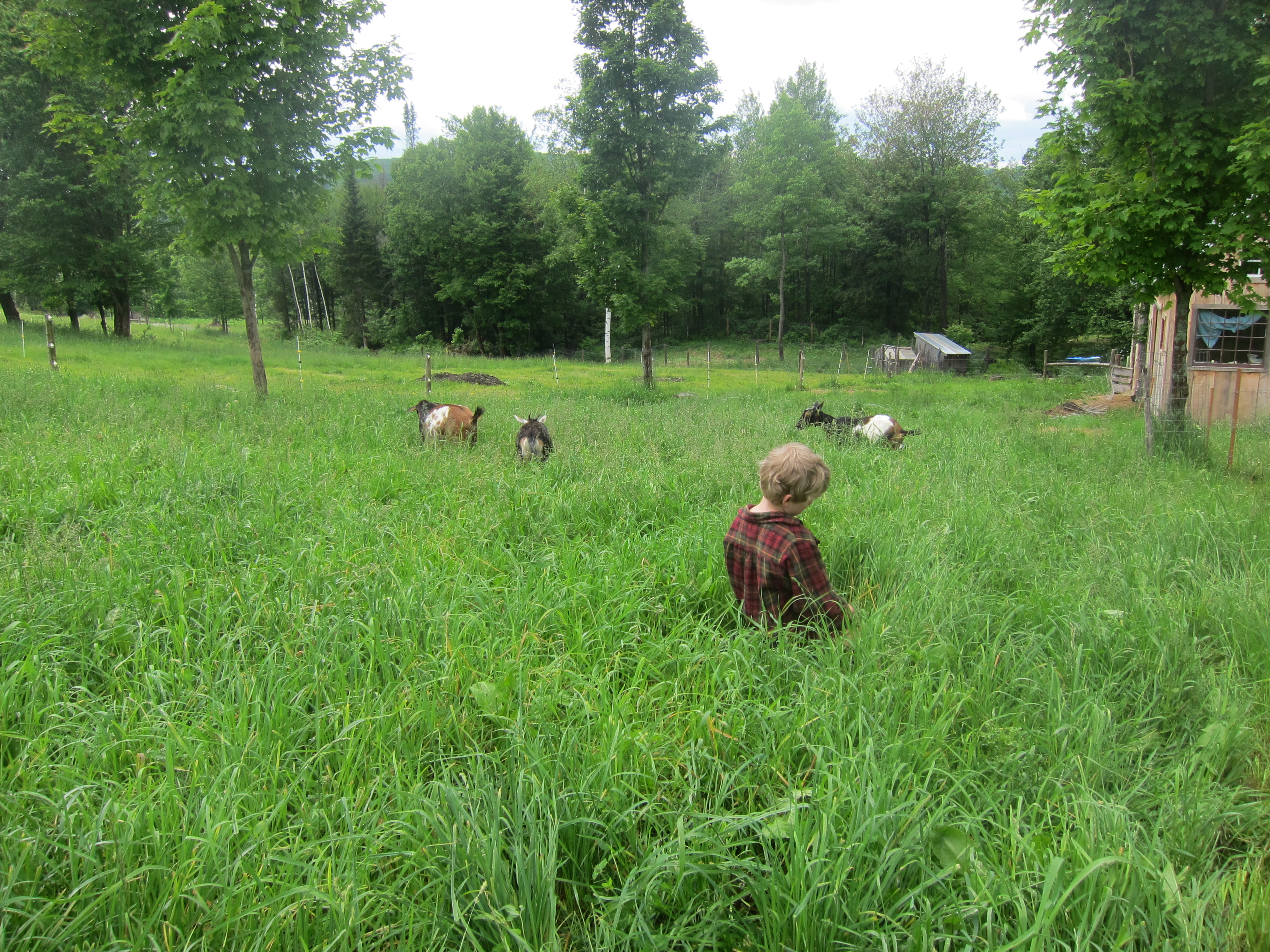
What’s interesting to me is how many of the aspects of our property that we first perceived as deficient, have become beloved. The hills, for instance: Our entire property slopes westward, with hardly a piece of ground level enough to accurately check the oil in our car. It is true that for optimum efficiency in growing, flat land would be preferable. But the sloping and undulating nature of our land has become one of our most-favorite things about it. There is a sense of energy to it; it is dynamic and flowing, with little hummocks scattered about so that there is always a view that can’t quite be realized from wherever one stands, but is near enough to being revealed that it beckons you forward. These same characteristics – slope and undulations – also mean that our property is home to numerous microclimates, which we are slowly learning to leverage for growing species that are not entirely suited to this region. This summer – thus far one of the wettest, if not the wettest, on record – we haven’t had to deal with any flooding, because once the soil becomes saturated, the pitch of our land carries the rain water into the valley below. Every day, I hump it up the hills of our pasture carrying bags of chicken feed, or reels of fencing, or a chainsaw, and I feel my heart thumping and the sweat on my brow, and I know I am lucky for the effort, that it may end up adding years to my life. Either that, or I’ll drop  dead of a heart attack in our pasture someday. Which wouldn’t actually be such a bad way to go; Penny and the boys could just dig a hole on the downhill side of me and give a little shove.

I could go on, but I suppose my point is this: We did not buy our ideal piece of property. We bought a piece of property that we could afford, and that despite its deficiencies, spoke to us. It wasn’t so much that we walked this land and thought that maybe we could make it work; it was that we walked this land and knew we’d found what we were looking for, despite the fact that it really wasn’t exactly what we were looking for. If that makes any sense.

It’s been a decade-and-a-half since we moved onto this land, and I often think about how profoundly this property has shaped our lives in ways that are utterly unique to it. To be sure, we have done our share of shaping – dug a pond, cleared for pasture, built a house – but I suspect the land still wields the greater power. For whatever reason, this is comforting to me.

The truth is, the land leads. We just follow.

Uncategorized

Hypothetical

Plumber in Training
Plumber in Training


A sneak peak from my current project:

What if the primary goal of a child’s education were to acknowledge and understand the connection between human wellbeing and the health of the natural world? What if our children were taught to identify every tree species in their community before they were taught their multiplication tables? What if their “standardized testing” included fire starting, songbird identification, and bread baking? What if, as part of their daily study, they were expected to spend a full hour outdoors, freed from toys, tools, and agenda? What if we placed as much value on feelings and relationships, as we do on information and knowledge? 

What if the point of an education were not to teach our children to assume control, but instead to surrender it? What if the point simply cannot be found or measured in the context of performance-based assessments, or projected lifetime income? What if the point of an education were to imbue our children with a sense of their connectivity, not merely to other humans, but to the trees and animals and soil and moon and sky? What if the point of life is to feel these connections, and all the emotions they give rise to? 

What then? 

Family, Farming, Parenting

Ridiculous

IMG_3959

This past weekend featured the first truly springlike days of the year, and as much as I’m fond of portraying myself as a rugged contrarian stoic who pays little heed to the capricious vagaries of a Vermont winter, the truth is I get as excited about spring as anyone.

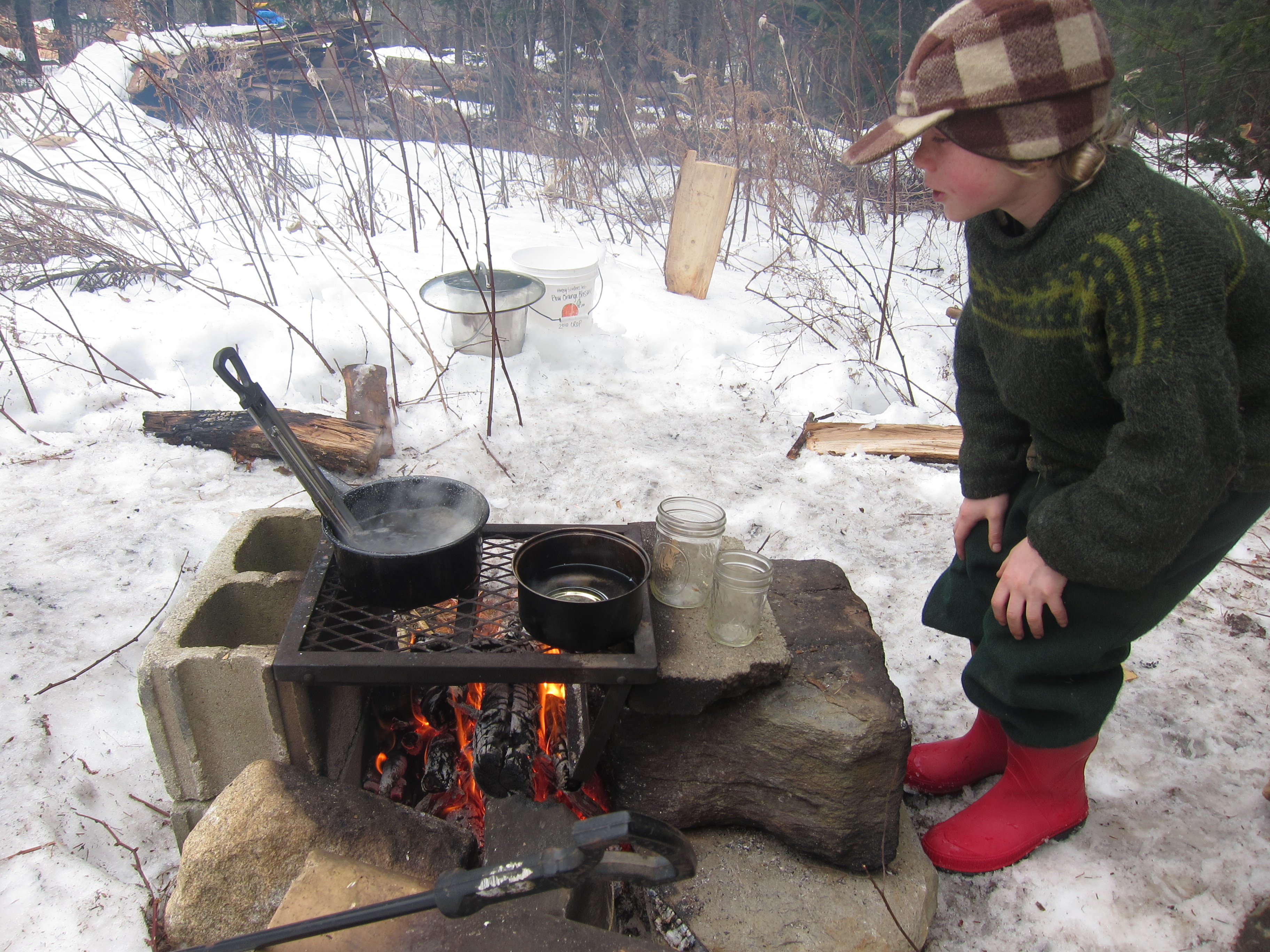
On Saturday morning, whilst waiting for sap to accumulate in the buckets we’d hung, and with the boys out scouting the woods for some innocent fur-bearing species or another, Penny and I split wood together (this is what passes for a date around these parts) and damned if I weren’t more than a few rounds into it before I was down to a tee shirt and feeling the first salted beads of sweat forming on my brow. Ah. We split for a bit more than an hour, then spent some time futzing with our cobbled together sugaring apparatus, and then, unable to resist, strolled down to the most prolific of our taps to assess the situation. Of course, there wasn’t nearly enough to be worth gathering, but there was plenty to be worth tipping a bucket or three to our mouths for a sample.

The way we sugar is frankly absurd. Our 60 or so taps (“just enough to be annoying,” is how one north country farmer described it to me) are spread across a broad sweep of fence line maples that extends for more than a quarter-mile down along our southern boundary. We transport sap in five-gallon buckets, either pulling them in a sled, or simply lugging them over the rotten snow, post-holing with each step, our shoulders slowly being extracted from their sockets until finally we capitulate and stop for a rest. It’s borderline ridiculous, or maybe not even borderline, given that our friends Jimmy and Sara make some damn fine syrup just up the road, which they sell at a fantastically reasonable price.

I have to admit that late on Saturday afternoon, after my second trip from the far reaches of our sugaring territory, with my arms screaming hellfire and my chin sticky from sap and sweat, and the dawning recognition that we’d so far collected enough for a single gallon of syrup at best, and still there was the straining and boiling and bottling and crikey, how many hours would we have into that single gallon, anyway? Three? Four? Yeah, I have to admit that at that precise moment, I was about ready to throw in the friggin’ towel on the whole damnable operation.

And at that precise moment, as I was standing in our yard, hoping my biceps would someday stop hating me, Rye emerged from the woods. He’d found a handful of errant sugar maples deep in our woodlot, and in his uniquely industrious way, had quietly tapped them. Both boys had assembled little fireplace rigs, and were excited to do some sugarin’ of their own.

So here I am in the yard with forty or so gallons of hard-earned sap arrayed around me in five-gallon buckets, and I’m about ready to collapse into a puddle of sorry-ass self-pity, and Rye’s carrying two sloshing buckets, which he’s hauled over hill and freakin’ dale. Speaking strictly in terms of weight and strength proportion, never mind terrain and distance (his haul exceeded mine in both regards), my eight-year-old had just out worked me by a country mile.

And the little bugger’s grinning to beat the band, holding onto his precious sap for dear life. “Look, Papa, look,” he said. “Do you think I have enough to boil?”

Suddenly, my arms didn’t hurt so much.


Uncategorized

Fear Sells, But Who’s Buying?

IMG_3131

I flew home from the PASA conference late Saturday night, having been bumped to first class after my regular seat had somehow been assigned to someone else. It was a short flight, and I was tired enough that I wasn’t inclined to accept the attendant’s repeated offers for free drinks and premium snacks, but still I found some pleasure in the absurdity of the situation. There I sat amidst the beautiful people of first class, shod in my “good clothes”: The shirt procured at a thrift store for a quarter, the pants hand-me-downs from a dear, departed friend, so loose around the waist that only my belt (a repurposed cow collar) stood between myself and sheer embarrassment (this simple fact had made security particularly challenging; when the TSA officer ordered me to take my hand off the waist band of my pants before passing through the human microwave, I had to explain that what the ramifications would be and was furthermore forced to admit that no, I wasn’t wearing underwear. He grunted and waved me through), the shoes another thrift store find, and finally, my socks, a product of the annual Darn Tough factory seconds sock sale for a buck-fifty. All-in-all, a five or six dollar wardrobe.

The conference was fantastic. I had the enormous honor and privilege of sharing keynote duties with Charles Eisenstein. If you’re not familiar with his work, I urge you to get thee to your local book seller and demand a copy of his most recent book, Sacred Economics. It will rock your world as surely and profoundly as a digitally remastered copy of AC/DC’s Back in Black turned up to 11. Even better were the conversations that blossomed practically everywhere I went. Although I am often invited to these sort of events to share my perspective, my barely-kept secret is that I almost always return home with so much more knowledge and experience than I arrived with. So, to any conference-goers who might be reading this, thank you.

In my hotel room, on the morning of my keynote, I awoke early. It was partly the result of the inevitable nervous energy that accompanies speaking in front of a couple thousand people, and partly the result of habit. No matter how certain I am that I will sleep in on the rare morning when my chore routine is disrupted, it never happens. So there I lay at 4:30 in the A of M, worrying that my belt would fail in front of the entire conference population, and unable to retreat into slumber. In my weakness, and seeking distraction, I reached for the remote and tuned into CNN, which was embroiled in round-the-clock coverage of Mega-Hyper-Storm Nemo (I hereby proclaim today Windy Monday Wendy), punctuated by repeated clips of the California cop-killer who, it was being said, had transformed southern California into an abyss of fear and rage.

I watched for an hour, transfixed. As you may know, we do not have a television, and the rich saturation of visual and aural stimulation, coupled with the endless mantra of disaster and death, was riveting. Or at least in was in these pre-dawn, hotel-room, keynote-jitters hours.

Finally, I snapped myself out of my stupor and shuffled to the bathroom to rinse myself of both sleep and, I hoped, the toxicity I’d absorbed over the previous 60 minutes. And as I stood there under the hot stream of water, I couldn’t help but think how different my life might be for only that one, simple element. I couldn’t help but think how profoundly I’d been impacted by a mere hour of contemporary television news media. One hour. And I couldn’t help think about how different the world might be if we all just said “no,” if we all resolved to save our attention and emotional space for the people and world at our fingertips, rather than allow them to be hijacked by stories of disaster and tragedy over which we can have no influence.

Yeah, I know: Fear sells. I get it.

So I guess the question I have is this: What if we just stopped buying?


Farming, Money

Payback

OLYMPUS DIGITAL CAMERA

So just a few days following my uncharitable comments regarding those who capitulate to their innate cowardice and flee the heart of Vermont winter like sad little rats slinking into the protective shadows, I found myself wanting, more than anything, to get the hell out. Just a day or two, and it didn’t even have to be somewhere warm… just somewhere different (at my lowest point, even New Hampshire would have sufficed), somewhere where an inch of rain wasn’t about to fall from the sky, bringing ruination to my daily ski and painting the whole damn place with an ugly brush. Everywhere, piles of cow shit and dog crap and all the small bits of detritus we never got around to picking up in November. There’s nothing like a hard rain in January to make our little farm feel dingy and ragged and sad, like some bassakwards, backwoods hovel where the father spends his days in a sprung recliner, intermittently snoozing off the prior evenings drunk and raving about the gubmint, while the wife stirs a pot of rendering lard on the cookstove and the children run feral through the woods, trapping and skinning small, fur-bearing animals. Wait a second…

As feared, I awoke this morning to transformation; the bulk of our pasture is now bereft of snow, and while there is a sort of crumpled, maudlin beauty to the faded browns that dominate the landscape, it felt as if I carried the weight of all that rain on my shoulders. I got the woodstove hummin’, made coffee, and shucked into my jacket for chores, the whole time wishing, pathetically, that we’d made so many different choices, choices that would have afforded us the freedom to simply close the door behind us and leave. No animals. No wood heat. More money. And all that.

Once outside, I smelled something at once familiar and strange, and for a moment I struggled to place it. And then I knew: Earth. The ground. I fed the pigs first, then the cows, and by now the sky was light enough that from the height of our land, I could see across the valley, to the patchwork of fields and forest that comprise Morgan and Jen’s farm and Lynn and Roman’s hayfield, where in five months we’ll be mowing and tedding and raking and baling and throwing bales until we literally shake from fatigue. I know it sounds strange, but for a second, I swear I could actually feel that fatigue, the memory of it stored somewhere in my synapses, and I stood there for a moment and let myself sink into it.

And that was it. That, right there, was the escape I needed. I came in from chores with the rain pattering my shoulders and smearing into the remaining patches of snow. I landed a boot in a pile of dog shit and then, on the very next step, slipped on a patch of ice and fell on my ass. Fifteen minutes prior, it would’ve made me curse my sorry life. But now, all it did was make me laugh.


Family, Farming

Baled Out

We just finished a 4-day stretch of haying and we are whupped. As always, it was satisfying beyond any logic or reason. We pulled the last few bales off the field yesterday afternoon just as the rain started falling, and it felt like someone was trying to tell us it was time to rest.

The following is excerpted from an essay I wrote last year. It will be published in an upcoming issue of Yankee magazine.

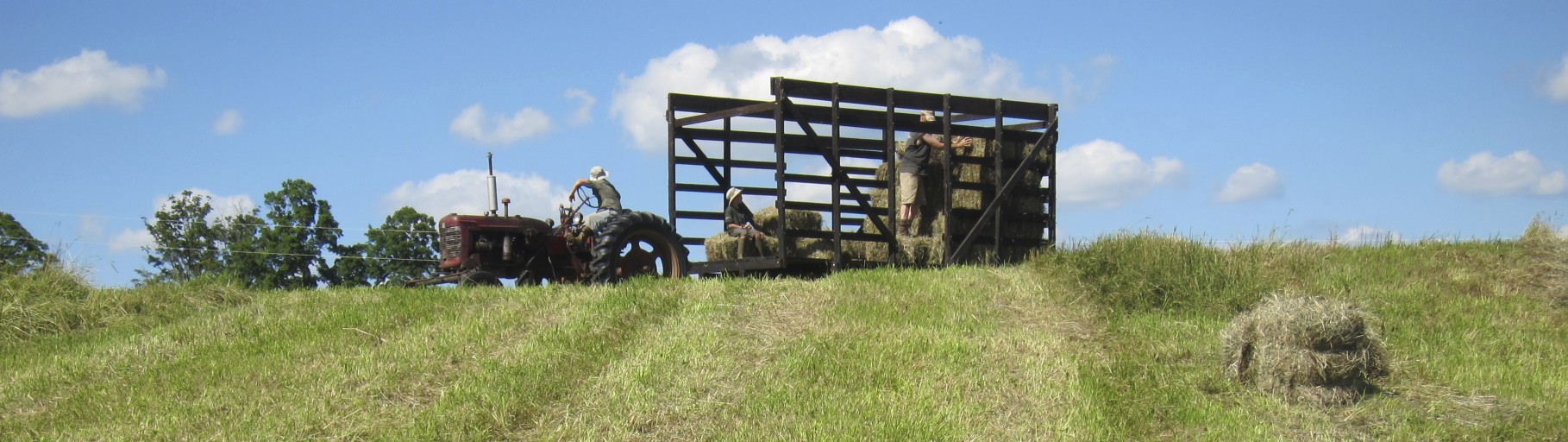
On haying days, Penny mixes thick milkshakes and we drink them on the ride home, the four of us crammed into the cab of our old Chevy. We idle down the winding gravel road from Martha’s hayfield; the loaded wagon pushes us, and I ride the brakes. Oncoming traffic gives us a wide berth, and wisely so. Everyone waves in that two-fingers-off-the-steering-wheel way rural Vermonters wave, as if afraid to commit to even this brief, passing relationship. I can smell the warm hay, the hot brakes, and the chopped up sprigs of mint Penny puts into the sweet slurry of cream, egg, and maple syrup. I can smell the sweat that has risen, flowed, and is now drying on my skin. It is not sour, or at least, not yet. My teeth hurt from the cold, and I know that my day is nowhere near over. There is this wagon to unload, and yet another to fill. There will be more tomorrow. But for the seven or eight minutes it takes to get home, I am afforded the simple luxury of the satisfaction only hard labor can provide, and I think ahead to the coming winter, when I will pull each of these bales out of our barn, one-by-one, extracts of summer in an iced-over world.

And I will remember how it happens every year that I improbably recognize a bale or two – maybe a runt from an early pass, when we were fiddling with the baler settings, or maybe one from the field’s edge, with an identifying stick woven in, shed from the old maples that line the northern fringe, overseers of more hay and toil than I can imagine.  And I’ll stand in our snow-packed barnyard for a minute, holding the bale, wrenched back to the moment I hauled it off the chute and tossed it to Penny or one of the boys as Martha guided the tractor down the long windrow, the smell of grease and diesel and drying hay riding softly on the summer air. 

It’s not a moment frozen in time, but rather just the opposite: A moment so fluid it can travel across weeks and even months to be with me at six o’clock on a January morning, to a point roughly equidistant from the haying season before and the haying season to come.

Then I walk up the short hill to the paddock, release the compressed hay from the confines of its twine, throw it over the fence, and leave the cows to their breakfast.