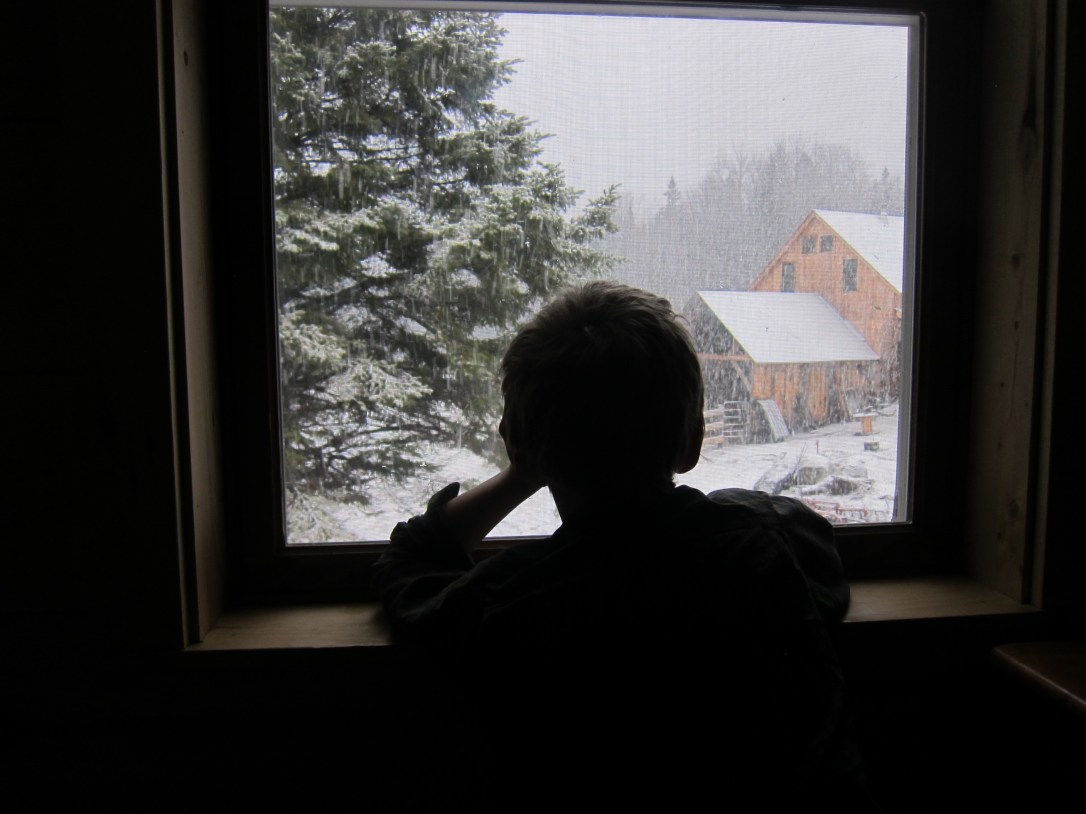
We awoke to a brush of snow, and when I went outdoors, I found the cows lying nose-to-tail along a windrow of composting wood chips, taking the rising heat into their bones. The snow is not unwelcome – it’s been too dry for too long – though a steady rain would be even better. Last week I passed a fire truck extinguishing an out-of-control brush fire, and a few days after that, a friend’s sugarwoods caught, kindled by a spark from the stack. An acre-and-a-half burned, and he’s grateful it wasn’t more.
It hasn’t rained since.
There is more to do than I know how to accommodate, or sometimes even consider. Strangely, last summer felt more relaxed than this summer is shaping up to be, probably because our task then was so clearly defined and understood, and everything else could go to hell. I mean, all we had to do was build a barn and a house. And move. Piece of cake, really. Plus, we had help, which cannot be underestimated, both for the increased capacity of labor and skills, but also (and perhaps equally) for the psychological boost.
We’ll be ok, of course. Things will get done, and that which doesn’t get done will get done later or ultimately be deemed unnecessary in the first place, and we’ll think to ourselves isn’t it lucky we didn’t do it back when we thought it had to get done, before we had a chance to realize it didn’t need doing at all?
It is noon now, the snow is still falling, the cows long since risen from their bed for feed and water. I bet when I go outside in a while they’ll be back on the chip pile, looking pleased with themselves in that distinctly bovine way, and I’ll amuse myself by imaging that their self-satisfaction is based on nothing more than realizing that all things they once deemed so important weren’t so important, after all.
And doesn’t it feel nice to rest those weary bones.
Our older boy is sick, so for the past nights I took his place at the barn where our sons do chores twice weekly. There I rolled the big round bale down the aisle with my younger boy, both of us leaning into it with all we had and a little more, the cows lapping the last pellets of grain off the floor, the late afternoon sunlight slanting through the west windows, dulled by decades of dust, everything caught in the ethereal suspension of day’s transition to evening. The smell of cow shit and fermented grasses, the sound the cows shuffling and chewing, and the banter – always the banter: So-and-so did so-and-so to so-and-so, if it’d only rain the grass would green right up, the big Swiss isn’t producing like she should, and wasn’t that one hell of a sugaring season. On it goes, one tale after another, some of them tall, some of them true, and some split right down the middle. Not necessarily true, but not altogether untrue, either, and you know that even that part that’s not true speaks a certain truth. If only you can figure out what it is.
Yeah. I like those ones. I think those are my favorite.
Sunday afternoon I walked up the hill to collect sap. I knew it would be the last gather; the evenings are too warm, now, and the trees are tired, anyway. I guess I’m a little tired, too; we’ve carried a lot of sap out of the woods, and spent a lot of days with the windows thrown wide to shed the heat of the wood stove as we boiled. The boys – whose job it is to keep the woodbox full – have soured on the task. Indeed, it has been a long sugaring season, almost ideal in every way – perfect weather, easy, snowless access to the woods, an extended cold snap to delay the onset of buds. I heard from someone who knows these sort of things that many sugar makers have run short on firewood. Records will be broken, I am sure of that.
Death (life)
So. Sugaring done. One more tick of the seasonal clock behind us. Now: Finish firewood, water the seedlings, plant the new trees and prune the old ones, run fence, watch the cow grow fat with calf. Soon: Tend the garden, bale the hay, swat and curse the black flies, eat the salad, drink the milk. And if no one’s looking, maybe just a drop or two of syrup to sweeten the glass.
PS: Some of you might be interested in this commentary I wrote.
Deep in the night I was woken by coyotes, and I realized it had been a week or better since I’d last heard them. They seemed farther away than usual, and I lifted head from pillow to better gauge the distance. Three-quarters of a mile, I decided, though it could just have easily been more. Or less. The dog slept at my side, not even stirring at the ruckus, and I was reminded of how much she’s aged, which in turn reminded me of a story I’m working on, about a large animal vet around these parts, a man nearing retirement after decades of veterinary service. He’s an institution, really, and the very first call I accompanied him on was to a small hill farm a ways south of here, where he put down the family’s beloved and tumor-riddled hound before crossing the road to the barn, where he spun the testicles off a year-old bull with a power drill. Then we left, dog dead in the pasture, bull dazed and confused (rightfully so, I’d say), balls going cold on the compost pile.
Then the coyotes stopped calling, and I stopped remembering things, and soon I was asleep again.
Also:
It is through immersive, hands on, participatory experiences in nature that connections to the wild are made deepest. Crafts are made to be used and not merely admired; wild foods are not a novelty, but rather the basis for nutritive meals; the forest isn’t simply a place to visit, but a vibrant eco-system in which we thrive and grow.
In this camp we will spend the first four days working on crafts and learning skills to take with us out into the woods for the three-day, three-night immersion period. We will create burden baskets out of willow and rawhide to carry our gear, as well as tree bark dishes and a cattail visor to protect our eyes from the sun. Other projects can include bow drill kits, plant fiber cordage, and wooden spoons, all from natural materials found in the surrounding forest.
The Details
Preparation Days: August 6th – 9th we’ll meet from 9am-3pm at our Lazy Mill Living Arts base camp. During these days our focus will be on readying crafts and foods that we will use out in the forest. This year the projects will be rawhide burden baskets, bark dishes, spoons and cattail visors. Throughout the day we will also play awareness games, cool off in the nearby stream, and work on camp skills.
Overnights: August 10th-12th students will get dropped at 9 am on Tuesday the 10th and be picked up at 3pm on Friday the 12th. For the overnights we will take the woods skills we’ve learned and crafts we’ve made with us out into the Steam Mill Brook Wildlife Management Area, where we’ll camp under lightweight tarp shelters, fish and forage for our meals, play nature games, explore the wilderness, tell stories, and laugh.
Please know that we always do our best to accommodate financial need; don’t hesitate to contact us at 802-533-2085 or info@lazymilllivingarts.com with questions. And please don’t let a lack of camping/outdoor gear stop you from signing up. We can help!
Snow in the night. Not much, but enough to hide the mud, a brief respite from that small despair. But it’s melting already and the mud is returning in patches, first in the wells of my footprints to the barn and back at morning chores, then along the high edges of the furrows created by the weight of the tractor when I moved firewood yesterday. A nice old beech, a big tree, straight-grained and easy-splitting. I’m thinking it’s a half cord at least, which probably means it’s a third at best, and probably closer to a quarter.
Yesterday I walked past the remaining fatted hog on my way to drop that beech. He was supine and snoring in his nest of hay. I laid the saw at my booted feet and paused to scratch behind his ears a minute. He stirred, rotated his big head according to his pleasure, and as I scratched I realized how wrong I was when I wrote recently that I don’t mind killing animals for meat. Because I do mind. Quite a lot, actually. Truth be told, I’m dreading killing this fellow, which probably explains why he’s still alive, though of course I’ve been careful to couch my procrastination in the language of practicalities: Weather, conflicting obligations, other priorities, and so on. But the excuses are fast slipping away.
So, yes, I mind. But what I don’t mind is minding, and I suppose that’s where my confusion originated, although now I’m left to wonder if I’m a more compassionate person because I am bothered, or less compassionate because I am bothered, yet will not allow this discomfort to dissuade me? Riddle me this.
Either way, I know I will kill that pig, and soon. He is eating too much to not kill, and we’ve been out of bacon and pork sausage for months, now (fortunately, the supply of beaver sausage remains ample). Soon enough, I suspect, the acceptance of my discomfort will become a bigger thing than the discomfort itself, and I’ll stop thinking about whether or not I’m a compassionate enough person, and just do it. Or maybe we’ll arrive at the juncture where the pragmatics can no longer be made to justify further procrastination, and I’ll be reminded (yet again) of how many things in this life – my life, your life, anyone’s life, I suppose – really just boil down to doing what needs to be done.
Our neighbor Scott runs a small chainsaw repair and sales shop. It’s tucked into clearing on a gravel road, constructed of rough sawn lumber and a cracked concrete floor. There’s a wood stove with a glass viewing door that’s been broken for at least a couple of winters. Like as not, there’s something wrapped in tin foil set on the stove’s surface to warm for lunch. Once, when I stopped by the morning after a storm, I found a snowmobile parked at the entrance and a sign on the front door: We’re out on the snowmachines. If you need us, take the Skidoo and follow our tracks. You can sort of see what kind of place it is.
We have two chainsaws, and they get used a fair bit, so I stop by the shop pretty often. Plus, it’s only about a half-mile up the road from our place, and sometimes I get lonely, so there’s that. But generally I like to have at least a plausible excuse, so I go to buy bar and chain oil, chains, air filters, and so on. I even go to have the saws worked on. Chainsaws can be a little finicky; they run at ridiculously high rpm’s (your car generally runs at about 3,000 rpm’s, while a chainsaw runs at about 13,000), and are subject to a fair bit of abuse, so it’s not uncommon for things to break.
Scott has a single employee, a 20-something fellow named Levi, who, far as I can tell, has been working on chainsaws since he had to be careful not to spill bar oil on his diaper. I like Levi a whole lot. He’s a Grade A bullshitter, a story teller, a yarn spinner. As one might imagine, we get along real good. (PS: I like Scott a whole lot, too)
Most of the things Scott and Levi fix on our saws are pretty simple, and I’m always a little embarrassed that I didn’t at least try to fix it myself. But then I wouldn’t have had the plausible excuse to stop by and shoot the breeze while one of them tinkers on my saw for a half-hour or so and then charges me $10. I’m not sure how they decide what to charge – no one watches a clock or writes anything down – but it’s almost always $10. If I need a part, it comes of one of the 1,000’s of salvage saws piled in one of the adjoining rooms. Come to think of it, the part’s usually about $10, too.
Often another customer stops in while I’m there. Scott and Levi are quite popular among career woodsmen, so like as not, the man coming through the door (and it’s almost always men; I rarely see women in there) makes his living in the woods. These are folks who buy bar oil by the case. They drive large-ish pickup trucks that are dented, because logger trucks are always dented, as if the standing trees are exacting some small revenge for their fallen brethren. They have heavy northern Vermont accents, and speak the vernacular common to the region. For instance, Don’t for doesn’t (as in, it don’t matter to me). Good for well. And ain’t. They tend to say ain’t pretty often. Shit and fuck get tossed around a fair bit, too. They have thick arms and thicker chests, or they’re wiry in that muscle-over-bone way, and if they’ve been cutting softwood, they carry the sweet smell of spruce and fir. They are usually cheerful but occasionally are not.
Wood is huge factor in our lives. We put up all our firewood, and we mill much of the lumber we use for our building projects. Just today I spent a couple hours bucking and splitting firewood, then a couple more hours running rough pine boards through a borrowed planer to make wall paneling. We warm our house with wood, we cook on wood, we make maple syrup and sugar on wood, our water is heated by wood, we build with wood Truth is, I bet we spend more time with our hands on dead trees then we do with our hands in the soil. Our lives are at least as dependent on the forest as they are on the garden, and I guess this makes sense, because for at least six months of the year ‘round these parts, you’ll freeze to death before you’ll starve.
What I’m saying is: Fire first. Then food. Remember that, and you’ll do just fine.
Yesterday morning we awoke to a swirling snow, and upon awakening I recalled that in the night I’d heard the gusting wind and in the haze of half-sleep thought to myself how much sounded like a chant. Rising, falling, leaving off and rising again, the pitch changing according to the force of the air behind it.
After chores, I walked into the woods to collect what sap had flowed in the hours between yesterday’s gather and the cessation of the run. The northwesterly faces of the trees bore long stripes of caked snow, driven by the wind. The ground was soft, the snow sticky enough to not be slippery. There wasn’t much sap. Five, maybe six gallons. I hauled it home. It’s on the stove right now.
I am working on a project with Heather, about our respective experiences with home schooling. It is audio-intensive and interactive, which means it will also be about the experiences of anyone who participates. I am really enjoying the process, in part because I’m sort of fascinated by the audio component (and huge thanks to Erica for so generously sharing her Great Wisdom), and in part because I’m sort of fascinated by the conversations Heather and I are having. She is one of those people who says tremendously insightful things without even realizing she’s done so. This is a quality I deeply admire, and though I know it’s a stretch, I’m hopeful some of it will rub off on me.
So far, Heather and I have talked a lot about our respective – and remarkably divergent – paths, about socialization and community, about the challenges we’ve faced, about deschooling ourselves, and about honoring averageness in both children and adults. We’ve also tried to answer the questions Heather solicited, while acknowledging that every question has many answers, and that neither one of us has this all figured out. We’re as imperfect as anyone. In my case, at least, perhaps even more so.
It’s fun for me to be doing something new, and I’m super-excited about the possibilities. If this project is successful (admittedly, I have no idea what success looks like in this context, but I trust we’ll figure it out along the way), Heather and I have talked about tackling other subjects via this medium. I think the audio component lends a lot of warmth and spontaneity to the collaboration; our conversations thus far have not failed to take us in surprising directions. It also offers a way for folks to participate away from the screen, although to be clear, there will be an online component as well.
While I hope Heather and I will be able collaborate on more of these projects, I’m also looking forward to exploring ways I can include audio in my other work. I’m not sure yet what this will look (sound) like, but I’m enjoying how just thinking about it is impacting the way I hear the world. I think that many writers – including myself – have a tendency to focus on the visual, even as we lose sight (pun intended) of smell, touch, sound, taste, and so on. For anyone interested in improving their writing, I think it’s a great exercise to include at least one description from every one of these senses in their next piece.
It’s been a pretty good sugaring season. The bigger producers I’ve talked to are at about 3/4 of a typical crop, and there should still be a couple weeks to go. I’m glad we hung some buckets; we skipped last year in deference to our preparations for moving, then felt the absence. You do something long enough, and it sort of imprints itself on you, and you don’t even realize it’s happened until you stop.
There is rawness to the landscape now that reminds me of November, though the angle of the March sun diminishes much of that autumnal sternness. And yesterday, while boiling sap atop the cookstove, windows open wide to disperse heat, I sat for a time and listened to a trilling birdsong, so different – softer, lighter – than the severe caws of winter crows and ravens.
Our focus has shifted outdoors, and there is much to accomplish, though the pressure of shelter is behind us. What we have now is a piece of land, our animals, some nursery stock, and our intentions, and the task before us is determining how each can best serve the other. It is a puzzle, nothing more, albeit one that demands a working knowledge of the braided connections between each of these facets. There’s no one right way to assemble the puzzle, but there are plenty of wrong ones, and in some ways I suppose this only makes it more confusing. If only there were one right answer. Then we could all be prophets.
Someone asked me this morning what it’s like to kill and eat animals we’ve known and loved, and I realized how long it’d been since I’d even thought about it, despite having killed two pigs just last week, and cut them on the very table I’m sitting at now. There was a point … no, wait, that’s wrong, there wasn’t a point. There was no specific moment. Instead, I guess I’d describe it as an evolution in both my understanding of the interplay between death and life, and also in my awareness of our animals’ role in the aforementioned puzzle. Which is to say, it is not life that begets life, but rather death; it is decay that necessarily precedes the bloom of regeneration.
I know this will sound callous to some, but it is nonetheless true: I do not mind killing animals I’ve known and loved. Actually, I’d prefer to kill animals I’ve known and loved, if only because it means I got to know and love them. To be sure, there is a certain anxiety inherent to the task, but I’ve come to accept it as an anxiety I must grapple with if my relationship to my livestock and my land is to be whole. I’m not saying it needs to be this way for everyone; I’m merely saying it needs to be this way for me.
Now I see clouds building; the forecast calls for a return to winter weather. It’s ok. We’re swimming in sap from a string of strong runs, and we need a break. We need time to boil. We shouldn’t have tapped; we don’t have a proper set-up, we’ve got way too many other balls in the air. But tap we did, and so just before lunch, I carried two overflowing five gallon buckets of sap down the hill from the sugarbush and through the fenced-in pasture, and as I passed, the cows watched me in that skeptical way they always do. The old fool, at it again. My arms ached, and I willed myself another 50 steps before rest.
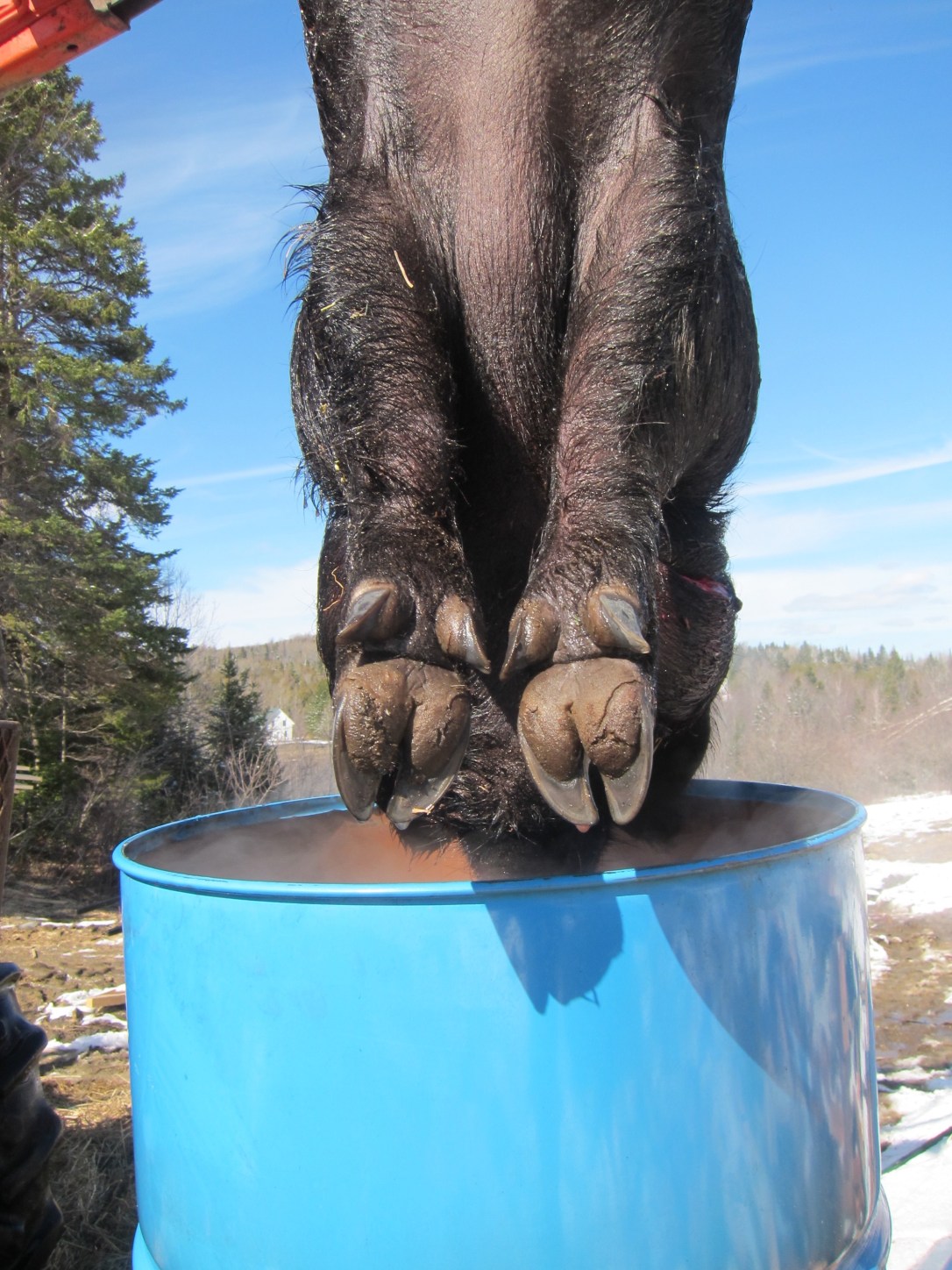
The sun shone all weekend long, high and welcome and almost hot. It was tee shirt weather, or at least it was if you kept moving. So that’s what I did. We killed and processed a fat hog, split firewood, then gathered sap from the distant sugarbush, glad for the aid of gravity in carrying it down the old skid path a quarter-mile or more. Ten gallons of sap per haul, maybe a quart of finished syrup. Makes you look at pancakes in a whole new light. Eventually, we’ll have a rig nearer to the sugarbush. Eventually.
The mud is the worst anyone has seen in years; for a period at the end of last week, many of the back roads were essentially impassible. Having grown up in Vermont and navigated better than four decades of mud seasons, I consider myself something of an expert in the craft. Still, I managed to sink the Subaru to the floorboards, though at least I was within easy walking distance to home, and the situation was soon enough remedied via truck, chain, and the oversight of my offspring, who seem to have inherited my unflattering delight in the application of brute force remedies.
I’ve been thinking a lot lately about how fortunate I am to live where I do, that just down the road there is a farm where often I see horses pulling sawlogs from the surrounding forest, that twice each week my sons go to work on a small dairy farm, where they unroll a round bale for the milkers and feed flakes from squares to the heifers, that yesterday afternoon on a short drive I passed no fewer than four sugarhouses in full boil. A visitor last summer told us that the thing he liked most was the simple fact that everywhere he went, he found people outside, just doing things. “It’s not like that where I’m from,” he told me.
Don’t let me romanticize this place. There is hardship aplenty in these hills: Deep, seemingly intractable poverty, drug use and abuse, capricious weather, that damnable mud. Soon, the perennial scourge of spring, black flies. Furthermore, Vermont is not immune to external pressures, and economic transitions are being imposed. The opportunities to make a reasonable living working the land on a modest scale are becoming fewer and farther between. I know some who still do so, but the hours are mostly unreasonable and probably not sustainable into the latter seasons of their lives. Nor are they finding it easy to set aside the money they’ll need to survive when their bodies succumb.
Those who have a certain cleverness with technology are finding workarounds (I suppose this includes myself, though “cleverness” may be a bit of a reach), but I cannot help wondering if is it just to leverage the very tools that are helping displace the working landscape in our quest to preserve it. There is an excellent piece by Thomas Frank in the new Harper’s, titled Nor A Lender Be: Hilary Clinton, Liberal Virtue, and the Cult of the Microloan. I’m going a close with a pertinent excerpt, but to fully understand the context, and perhaps gain other significant insights, I highly encourage you to read the entire article.
… The so-called Twitter Revolution fit neatly into the beloved idea that new communications technologies – technologies invented or dominated by Americans, that is – militate by their very nature against dictatorships, a market-populist article of faith shared everywhere from Wall Street to Silicon Valley.
Then there was the economic side of the single, unified Internet, and it, too, was all about liberation. For the “people at the bottom of the world’s economic ladder,” Hilary Clinton averred on that day in 2010, the Internet was a savior. She knew of farmers in Kenya who were using “mobile banking technology,” and of “women entrepreneurs” somewhere else in Africa who were getting “microcredit loans,” and of a doctor who used a search engine to diagnose a disease. I guess she hadn’t heard about what these same technologies were doing to the livelihoods of journalists or musicians or taxi drivers in her own country, but I quibble; as long as this technology was free, anyone could see that it pushed in one direction only, and that was up.
The sun was high and strong for most of the weekend, and yesterday afternoon I walked up the hill to where our 30-ish buckets hang, listening hopefully for the telltale metronomic plink of dripping sap. But it was barely above freezing, and the trees had yet to loosen up, so I found only dry buckets and heard only the near-silent movement of a lazy breeze through the leafless forest. I turned and walked back down the old skid path, the red-and-yellow steeple of the old town church visible in the distance. I like seeing that steeple, it’s settling to me. The new leaves will hide it soon enough.
Just as well the sap didn’t run, I guess. We’d promised ourselves not to sugar this year, to instead apply ourselves to the long list of tasks forsaken in last summer’s quest for tin over beasts both human and otherwise. But then the days began to stretch at both ends, and we felt the sun on our sallow cheeks, and we began to overestimate ourselves the way we often do. In a fit of ambition, I took to a dense copse of spruce and fir that kept the garden in full shade during the mid-morning hours. Got a few sawlogs out of the deal and a big ole burn pile. I picked up three piglets to supplant the three that have yet to find their way to the freezer, but which will soon be making that one-way journey. Bucked up the first of next winter’s stovewood, a honking big red maple gone soft in the heart, and a smaller white birch. I love birch. Best quick-cooking wood there is, takes off like a rocket. Penny built a seedling shelf and prepped for onions. The boys hunted rabbits and we ate them for dinner one evening and again for breakfast the next morning. Michael owed us a day of work in exchange for the sawlogs I’d hauled for him, so he came by and he and Penny and the boys framed walls in the upstairs while I cleaned up some of the mess I’d made of the trees, and we joked that instead of paneling the walls, we should just add studs at three-inch spacing, as if the boy’s rooms were actually jail cells.
Well. I guess you had to be there.
My conversation with Erica provoked some interesting discussion (along with some great photos submitted by other folks). No doubt much more could be said about judgement and ambivalence and abnegation of self. Actually, I’m not sure what abnegation of self is, though it probably wouldn’t take too long to figure out.
But right now I mostly feel like shutting up and getting back to work.
 We awoke to a brush of snow, and when I went outdoors, I found the cows lying nose-to-tail along a windrow of composting wood chips, taking the rising heat into their bones. The snow is not unwelcome – it’s been too dry for too long – though a steady rain would be even better. Last week I passed a fire truck extinguishing an out-of-control brush fire, and a few days after that, a friend’s sugarwoods caught, kindled by a spark from the stack. An acre-and-a-half burned, and he’s grateful it wasn’t more.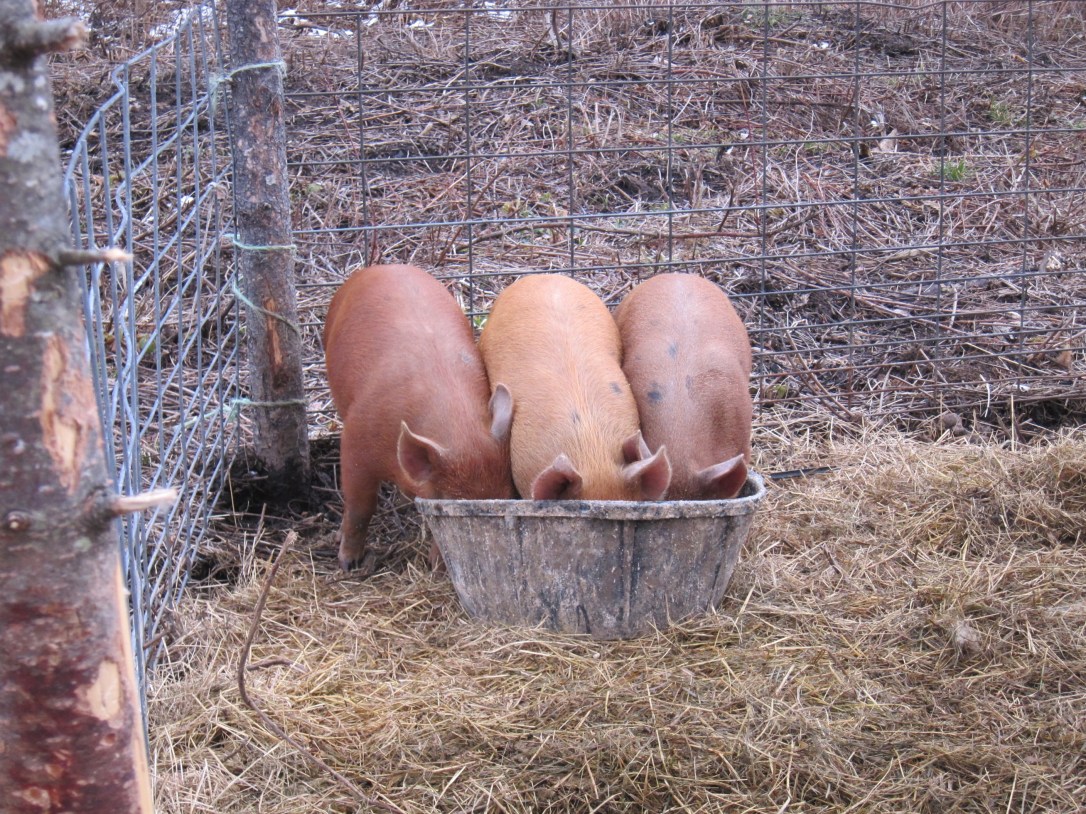




 Ben Hewitt